


TL;DR:
- Convenience in golf influences course flow, accessibility, and player focus, beyond just gadgets and gear. Enhancing pace, inclusivity, and safety through proper systems and thoughtful design creates a better experience for all players. Embracing convenience as a standard fosters respect, fairness, and long-term enjoyment of the game.
Convenience in golf is widely misunderstood. Most players assume it means gadgets, apps, or a nicer bag. But the role of convenience in golf runs deeper than that. It shapes how smoothly your round flows, whether certain players can participate at all, and how focused you stay from the first tee to the 18th green. When convenience breaks down, so does your rhythm, your patience, and ultimately your enjoyment of the game. Understanding what convenience actually includes — pace systems, accessibility tools, course technology, and smart gear design — gives you a real foundation for improving every round you play.
Table of Contents
- How convenience affects pace and flow on the course
- Accessibility and inclusivity: The role of golf carts and safety considerations
- Convenience accessories and technology enhancing the golfer’s experience
- Trade-offs between walking and cart riding: Matching accessories to play style
- Leveraging system design and enforcement for smoother, more convenient rounds
- Rethinking convenience in golf: Beyond gadgets to inclusivity and flow
- Explore premium golf accessories designed for convenience and style
- Frequently asked questions
Key Takeaways
| Point | Details |
|---|---|
| Convenience preserves pace | Streamlining processes during play helps maintain rhythm and reduces slow play disruptions. |
| Carts enhance accessibility | Using golf carts supports inclusion for players with mobility issues but requires safety governance. |
| Gear boosts enjoyment | High-quality accessories and technology improve organization and comfort on the course. |
| Match gear to play style | Accessory choices should reflect whether you walk or use a cart to optimize convenience. |
| Systems matter too | Course policies and pace-of-play enforcement play a crucial role in a convenient, fair golf experience. |
How convenience affects pace and flow on the course
Slow play is one of the most common complaints among regular golfers in the United States. It does not just add time to a round. It interrupts your mental rhythm, forces you to stand still for long stretches, and breaks the physical and psychological tempo you have been building since the first hole.
“Convenience features that reduce friction help preserve rhythm when slow play disrupts routines.” This is one of the most practical and measurable aspects of why convenience matters in golf for everyday players.
The PGA Tour making pace of play public is a direct response to this problem. When players know their shot times are tracked and visible, behavior changes. The same principle applies at the recreational level: courses that communicate expectations clearly and measure performance create a more predictable, consistent environment.
Here is what convenience factors in golf look like when applied to pace and flow:
- Shot timing tools give players data about their own tendencies, revealing where personal delays occur
- Rangefinders and GPS devices eliminate the time spent pacing off yardage or searching for markers
- Quick-access gear systems reduce the time spent digging through a bag between shots
- Visible pace benchmarks communicated by the course keep groups aware of their position
Learning to master the golf convenience workflow is not about moving faster than you are comfortable with. It is about removing unnecessary friction from the moments that should not require much time at all, like finding your towel, locating a tee, or calculating a yardage. When those micro-delays disappear, your focus stays where it belongs.
Accessibility and inclusivity: The role of golf carts and safety considerations
Beyond pace and flow, convenience also means increasing who can access the game at all. Golf carts are the most visible tool for this purpose, and they do far more than reduce walking distance.
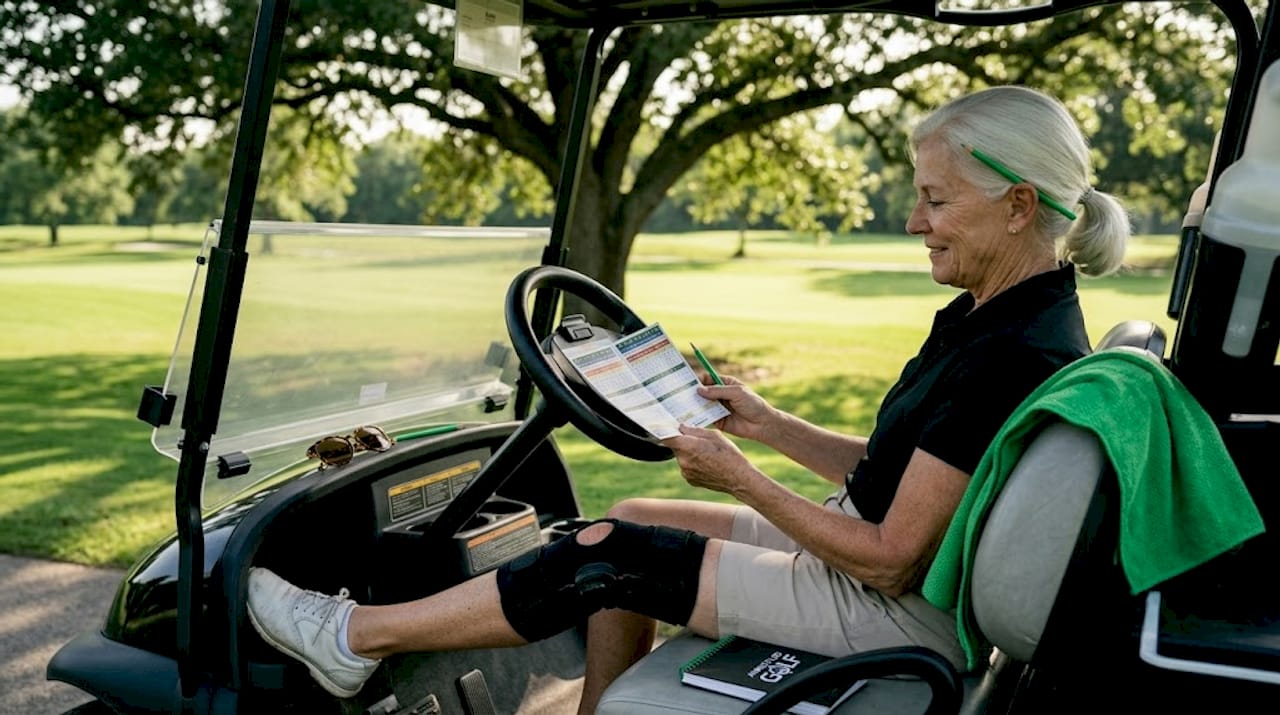
Golf carts promote accessibility for individuals with physical disabilities, chronic pain conditions, and mobility limitations by reducing the cardiovascular and musculoskeletal demands of a full round. Clubs that allow cart use in appropriate circumstances are better positioned to meet legal accessibility requirements and serve a broader player base.
| Accessibility benefit | Details |
|---|---|
| Reduced physical demand | Allows participation for players with mobility or endurance limitations |
| Longer playing careers | Older golfers can continue playing at higher frequencies |
| Inclusion of new demographics | Players recovering from injury or surgery can stay in the game |
| Legal compliance | Helps courses meet accessibility standards under applicable regulations |
Safety concerns, however, are a real factor. Most cart-related incidents occur outside professional settings due to operator error, poor terrain management, and inadequate safety governance. These issues are not inherent to cart use; they are management failures. Courses that set clear usage policies, define on-cart vs. off-cart zones, and train staff appropriately can reduce risk significantly.
Pro Tip: If your course allows carts but has not clearly defined its usage policies for players with disabilities, encourage course management to review their guidelines. Clear policy protects both the club and its players, and it removes the cultural stigma that sometimes discourages players from requesting a cart even when they genuinely need one.
Investing in the right best golf cart accessories can also improve both safety and organization while riding, turning your cart into a well-arranged mobile station rather than a cluttered seat with a bag strapped to the back.
Convenience accessories and technology enhancing the golfer’s experience
Having covered accessibility tools like carts, the next layer of convenience involves the personal gear and technology that directly affect your performance and comfort during a round.
Technology including apps and wearables is reshaping how golfers approach their game, not just by improving accuracy but by removing low-value tasks that consume mental energy. Mobile apps that allow you to order food from the course midway through a round, for example, mean you are not thinking about time pressure or hunger when you need to focus on a critical approach shot.
Key categories of convenience-focused gear worth your attention:
- High-quality golf shoes with modern comfort features reduce fatigue and improve stability on uneven terrain, which matters more on courses with significant elevation changes
- Laser rangefinders replace time-consuming yardage estimation with instant, accurate data
- Magnetic towels and landing pads allow immediate access and one-handed return without searching your bag or unclipping anything
- Utility pouches organized by function keep tees, ball markers, and divot tools in exactly the same place every round
- GPS watches and swing sensors provide real-time data without requiring you to look at your phone
Exploring quick-access golf gear is one of the fastest ways to experience the importance of convenience in golf firsthand. When every item you need is exactly where you expect it, your pre-shot routine tightens and your mental load drops noticeably.
Pro Tip: Test your own bag setup before a round by doing a dry run. Reach for your towel, a tee, and your ball marker without looking. If you have to search for any of them, your gear is working against you. Learning more about ergonomic golf accessories can help you build a setup that works instinctively.
Newer smart design golf accessories take this further by integrating multiple functions into single, low-profile items that do not add bulk or weight to your carry.
Trade-offs between walking and cart riding: Matching accessories to play style
With this foundation in place, the practical question becomes: does your convenience setup actually match how you play? Walkers and cart riders have genuinely different needs, and treating them as the same often means your gear solves the wrong problems.
Convenience trade-offs differ between walkers and cart riders, particularly around fatigue, playing tempo, and how accessible your gear needs to be at any given moment. Walkers accumulate more physical fatigue over 18 holes, and their gear must account for weight, ergonomics, and easy retrieval while moving continuously.
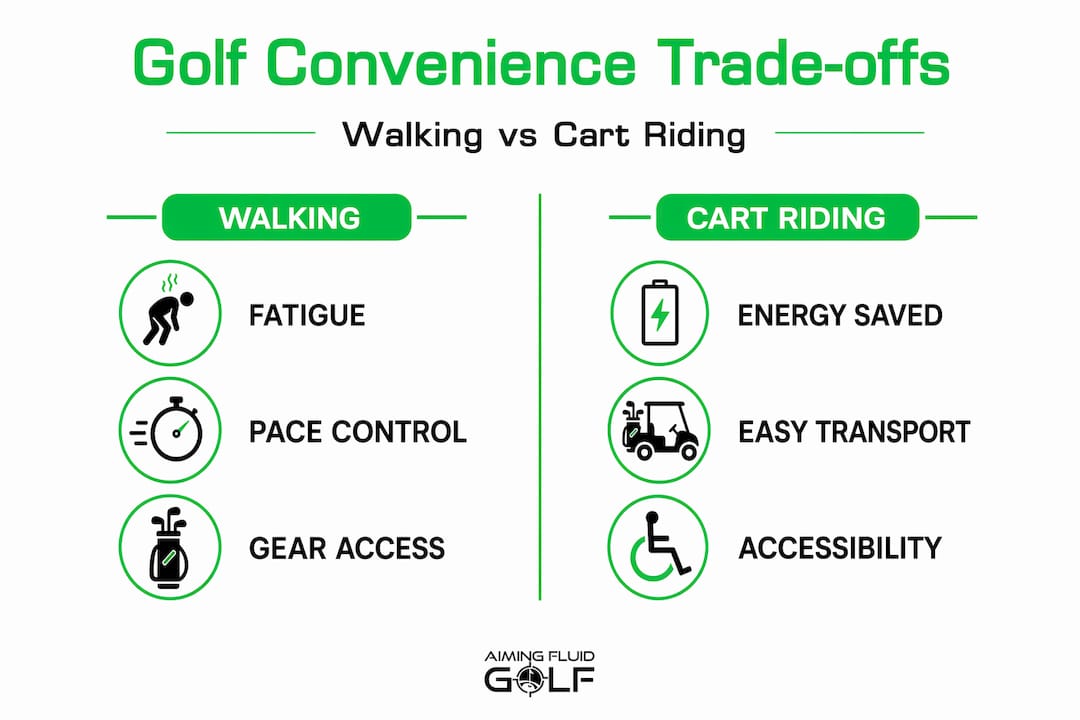
| Factor | Walking | Cart riding |
|---|---|---|
| Physical fatigue | Higher; gear weight matters more | Lower; exertion is reduced |
| Gear access | Must be reachable while moving | Can be organized at cart station |
| Tempo | Generally more consistent | Can vary depending on cart positioning |
| Terrain impact | More significant | Partially mitigated by cart path |
| Accessory priority | Lightweight, ergonomic carry solutions | Quick-mount, cart-specific organizers |
Here is how to match your accessories to your play style:
- Identify your primary fatigue point. Walkers often cite shoulder and lower back strain from bag weight; cart riders report less physical fatigue but more time lost to gear searching at the cart.
- Map your gear retrieval patterns. Track which items you reach for most often during a round and ensure those are the most immediately accessible.
- Evaluate your terrain regularly. Courses with steep grades demand more from walking players; energy differences walking vs riding are amplified on challenging terrain.
- Test your setup in conditions that mirror your play. A carry bag that works on a flat course may become a liability on a hilly one.
- Reconsider your setup seasonally. Heat, rain, and cold all affect fatigue and gear performance differently.
Exploring golf gear ergonomics and reviewing integrated golf system examples can help you build a cohesive setup rather than a collection of unrelated purchases.
Leveraging system design and enforcement for smoother, more convenient rounds
Beyond individual convenience, the systems a course builds around pace management and player communication directly shape your experience in ways no single accessory can replicate.
Predictable pace standards reduce rhythm disruptions and improve overall player experience. This is not about rushing; it is about building a consistent framework where every group knows what is expected and can plan accordingly.
What effective course-level convenience systems include:
- Clear signage at each tee box communicating expected hole times and group positioning
- GPS-enabled cart tracking that allows course rangers to monitor pace in real time without confrontational interactions
- Pre-round briefings that set expectations for new or infrequent players who may not know the course’s pace norms
- Staggered tee time spacing that accounts for group size and player experience levels
“Convenience matters indirectly via system design and enforcement: predictable pace standards reduce rhythm disruptions and improve player experience.” This is the dimension of ease of play in golf that rarely gets discussed but affects every round from start to finish.
Policy enforcement also matters. When slow-play rules exist but are not applied consistently, the burden falls on individual groups to manage their own pace while tolerating others who do not. That creates frustration, not convenience. Reviewing thoughtful golf design principles reveals how course layout and operational decisions function as invisible convenience infrastructure.
Rethinking convenience in golf: Beyond gadgets to inclusivity and flow
Here is where the conventional view of golfing with convenience falls short. Most discussions treat it as a purely personal matter, as though buying the right gear is all it takes to solve the problem. That framing misses the social and structural dimensions that are equally important.
Convenience intertwines with inclusivity and safety, challenging traditional golf culture while enhancing access and fairness. The stigma around cart use is a real example of this. Many players who could benefit from riding feel social pressure to walk because of unspoken cultural norms equating walking with seriousness and commitment. That stigma has a measurable cost: it keeps some players from participating comfortably, shortens playing careers unnecessarily, and reinforces an exclusionary culture that does not serve the game’s long-term health.
The role of convenience on the golf course is not just about moving faster or finding your towel quickly. It is about building an environment where players of different physical abilities, experience levels, and age groups can all participate without friction. That requires both equipment and culture to move in the same direction.
Courses and golfers who embrace smart design in golf accessories as part of a broader commitment to thoughtful play are modeling what modern golf can look like. And players who master the golf convenience workflow at a personal level are contributing to a better on-course environment for everyone in their group.
The most useful shift in thinking is this: treat convenience not as a luxury feature, but as a standard of respect, for your own experience, and for the players around you.
Explore premium golf accessories designed for convenience and style
Every point in this article comes back to one practical question: does your current gear support the kind of round you want to play?
Aiming Fluid Golf designs accessories built specifically around the convenience factors that matter most to regular U.S. golfers. From magnetic towel systems that attach and detach in a single motion, to precision-organized utility pouches that keep your essentials exactly where you expect them, our products address real friction points rather than aesthetic ones. Browse the full best golf accessories expert picks to find gear matched to your play style, or explore the complete top picks golf accessories for walkers and cart riders alike. If you are ready to start with one upgrade that changes your routine immediately, the magnetic golf towels collection is the right place to begin.
Frequently asked questions
How does convenience affect the pace of golf play?
Convenience features reduce delays and friction, helping golfers maintain rhythm and faster play, especially when slow play disrupts routines and breaks the tempo built over multiple holes.
Do golf carts provide any competitive advantage?
Golf carts reduce physical demand and fatigue, which may provide an endurance advantage in specific circumstances; riding reduces physical demands in ways that can matter across multi-day or terrain-heavy events.
What are the safety concerns related to golf cart use?
Safety risks mainly arise from operator error and poor governance in recreational settings; safety concerns arise in non-elite settings where proper oversight and training are often absent.
How do technology and accessories improve golfer convenience?
Wearables, apps, and well-designed gear reduce retrieval time and aid organization; apps and wearables streamline experiences and allow golfers to stay focused on performance rather than logistics.
Should walking golfers and cart users choose different accessories?
Yes, because convenience trade-offs differ between the two modes; walkers benefit most from lightweight ergonomic gear, while cart riders gain more from quick-mount, organized storage solutions.


