


TL;DR:
- Using properly placed quick-access tools reduces retrieval time and minimizes mental distractions during a round.
- Consistent organization and disciplined routines turn simple accessories into habits that enhance pace and focus.
Most golfers assume that buying better accessories automatically leads to faster, smoother rounds. That belief is understandable, but it misses the most important variable: how and where you use those tools. A magnetic towel clipped to your bag does nothing if you still pause to think about where it is. A precision divot tool buried in a crowded pouch creates friction, not flow. This article clarifies what “quick-access” really means, how strategic tool placement reshapes your on-course workflow, and what behavioral habits separate golfers who genuinely play faster from those who just carry nicer gear.
Table of Contents
- What are quick-access golf tools and why do they matter?
- How quick-access tools reshape your on-course workflow
- Organization and mental focus: The hidden benefits
- Common pitfalls and how to make quick-access tools truly effective
- Why accessory discipline, not spending, is the true game-changer
- Ready to upgrade your golf experience?
- Frequently asked questions
Key Takeaways
| Point | Details |
|---|---|
| Strategic placement | Where you position tools matters more than how many you own for faster, smoother play. |
| Routine discipline | Speed and convenience benefits only appear when your habits are structured and consistent. |
| Organization powers focus | Quick retrieval reduces distractions and helps maintain mental clarity on the course. |
| Upgrade plus behavior | The best results come from pairing premium tools with a self-check routine and organized workflow. |
What are quick-access golf tools and why do they matter?
Let’s start with what makes a golf tool “quick-access” and why it’s more than a convenience feature.
Quick-access golf tools are designed for one-handed, grab-and-go use. They rely on mechanisms like magnetic attachment, spring-loaded clips, or dedicated compartments to stay in a fixed, predictable location. The defining characteristic is that you never have to search for them. Your hand goes to the same spot every time, retrieves the tool without looking, and returns it without breaking stride.
The most commonly used quick-access tools on the course include:
- Magnetic golf towels that snap to a bag ring or cart frame
- Ball markers stored in a dedicated pocket or on a magnetic surface
- Divot repair tools clipped to a bag strap or belt loop
- Club brushes attached magnetically or via carabiner
- Specialty tee holders with quick-release mechanisms
- Utility pouches with segmented compartments for tee, marker, and ball storage
Each of these tools addresses a specific recurring micro-task during a round. And faster golf gear retrieval is not just about comfort. It directly affects how long each hole takes. When you multiply a 10-second search delay across 18 holes and four players, you can easily add 10 to 15 minutes to a group’s total round time.
According to USGA guidance on pace-of-play pain points, quick-access golf tools mainly work by reducing time and friction during recurring course micro-tasks. The USGA recommends keeping your pre-shot routine under 20 seconds. Quick-access tools support that goal by removing the retrieval and replacement steps from your cognitive load entirely.
“The pre-shot routine only works as intended when the mechanical steps around it—finding your marker, cleaning your ball, repairing your divot—are automated and fast.”
Consider the difference between a golfer who clips their towel back to the same magnetic ring after every club wipe, versus one who tosses it into an open bag pocket. After 18 holes, the first golfer has made 30 to 40 zero-effort placements. The second golfer has spent cumulative minutes hunting through their bag. If you want to organize your golf bag for real performance gains, the first step is assigning every quick-access tool a permanent, reachable home.
How quick-access tools reshape your on-course workflow
Now that we know what quick-access tools are, let’s see how strategically using them transforms your in-round experience.
Think of your round as a series of micro-routines. At the tee box, you tee up, take a practice swing, address the ball, and swing. On the green, you mark, clean, read, and putt. Each micro-routine has a support sequence: retrieving tools, using them, and returning them. Most golfers focus exclusively on the shot itself and treat the support sequence as an afterthought. That’s where time and mental energy silently disappear.
Here is a structured greenside and tee workflow built around quick-access tool use:
- Approach the green. Before you reach your ball, unclip your divot tool from its fixed position.
- Mark your ball. Retrieve your ball marker from a magnetic surface or dedicated slot without looking.
- Clean your ball. Use your magnetic towel, which is already in the same spot it was last time.
- Repair your divot. Use the divot tool already in your hand from step one.
- Return all tools. Before you crouch to read the green, each tool goes back to its home position.
- Putt. Your pre-shot routine starts with zero pending retrieval tasks.
This sequence is repeatable, fast, and cognitively light. Compare it to what happens without a system: you check your pockets, unzip a pouch, look for your marker, realize your towel is somewhere in your bag, and then try to focus on a 10-foot putt.
| Task | Conventional setup | Optimized quick-access setup |
|---|---|---|
| Locating ball marker | 8 to 12 seconds | Under 2 seconds |
| Retrieving towel | 10 to 20 seconds | Under 3 seconds |
| Finding divot tool | 5 to 10 seconds | Under 2 seconds |
| Total per hole | 23 to 42 seconds | Under 7 seconds |
| Cumulative 18 holes | 7 to 13 minutes | Under 2 minutes |
The time savings are real and compounding. But the deeper gain is cognitive. The USGA notes that golfers should design their greenside and tee workflow so that frequently used items are always in the same reachable location. That consistency is what converts a good tool into a genuine convenience-oriented golf routine.
Pro Tip: Assign every quick-access tool a named “home position” before your next round. A magnetic towel ring, a designated clip for your divot tool, a front pocket slot for your ball markers. Write it down if necessary. Return each item to its home after every use. Within three rounds, this becomes automatic.
Common mistakes that undermine even premium accessories:
- Random placement: Dropping your towel over the bag zipper instead of snapping it to its magnetic ring.
- Tools getting buried: Mixing quick-access items with range finders, snack bars, and rain gear.
- No reset discipline: Finishing a round with tools scattered, then starting the next round in the same disorganized state.
If you want to benchmark your current setup against top time-saving accessories, start by tracking how long your greenside routine actually takes. Most golfers are surprised.
Organization and mental focus: The hidden benefits
Once your routine is efficient, consider the bonus gains: clear focus and fewer course mental errors.
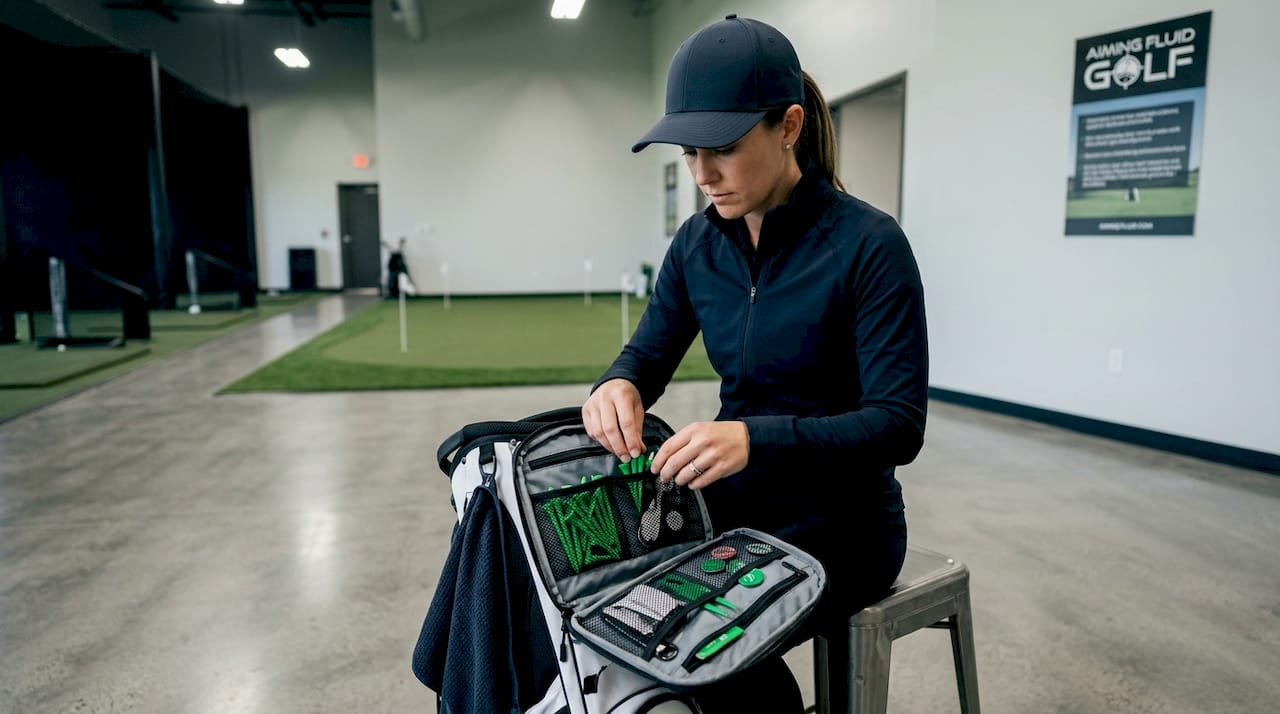
Every interruption in your routine fragments your attention. You don’t just lose time when you search for a tool. You lose thread. The mental state required to execute a consistent golf swing relies on what sports psychologists call a “pre-performance routine,” a repeatable sequence of actions and thoughts that primes the nervous system for execution. Breaking that sequence to search for a ball marker is not a neutral event. It is a small but measurable disruption.
Research on enhancing athletic focus naturally identifies distraction management as a primary factor in sustained performance. Golf is unique because players face repeated execution demands over four or more hours. Managing distractions during that time is not optional; it is a core performance skill.
| Distraction type | Time lost | Error risk increase | Frustration level |
|---|---|---|---|
| Searching for ball marker | 8 to 15 seconds | Moderate | Low to moderate |
| Missing towel before tee shot | 10 to 25 seconds | Moderate to high | Moderate |
| Digging for divot tool at green | 5 to 12 seconds | Low to moderate | Low |
| Misplaced tee holder at box | 10 to 20 seconds | Low | Moderate to high |
The compounding effect is significant. Three or four of these interruptions per hole adds up to dozens of micro-disruptions per round. Each one nudges your attention away from shot execution and toward inventory management.
Quick-access tools minimize time off-task, allowing your between-shot routine to operate closer to autopilot. When retrieval is automatic, your brain stays in performance mode rather than logistics mode.
One tactical approach is to use trigger habits. Before you leave the green, touch your divot tool to confirm it is back in its clip. Before each tee shot, glance at your towel to confirm it is in position. These two-second habit checks take almost no time, but they reinforce the system and prevent the small lapses that escalate into disorganized rounds.
“Accessories are most effective when paired with behavioral changes, not just purchase.”
For golfers interested in streamlining workflow for mental clarity, the takeaway is direct: organized tools reduce the number of times your prefrontal cortex has to step in to solve a logistics problem during your round. The fewer those interruptions, the more mental resources stay available for reading greens, managing wind, and making smart club selections.
Common pitfalls and how to make quick-access tools truly effective
To get the full benefit of your investment, avoid the following traps and follow these actionable steps.
The USGA’s pace-of-play research makes a clear point: speed and organization benefits are not guaranteed by purchase alone. Accessories are most effective when paired with behavior changes. That is the most frequently overlooked fact in golf gear discussions.
The three most common mistakes golfers make with quick-access tools:
- Buying but not using. A magnetic towel snap-ring attached to a bag strap works only if you actually snap the towel back every time. Dropping it over the strap instead of connecting it defeats the entire mechanism.
- Random placement. Storing quick-access items in different pockets or positions depending on what was convenient last time you reached into the bag. Inconsistency forces your brain to search each time.
- Ignoring the reset. Finishing a round without returning tools to their home positions, then starting the next round in the same scattered state. Rounds end; habits don’t.
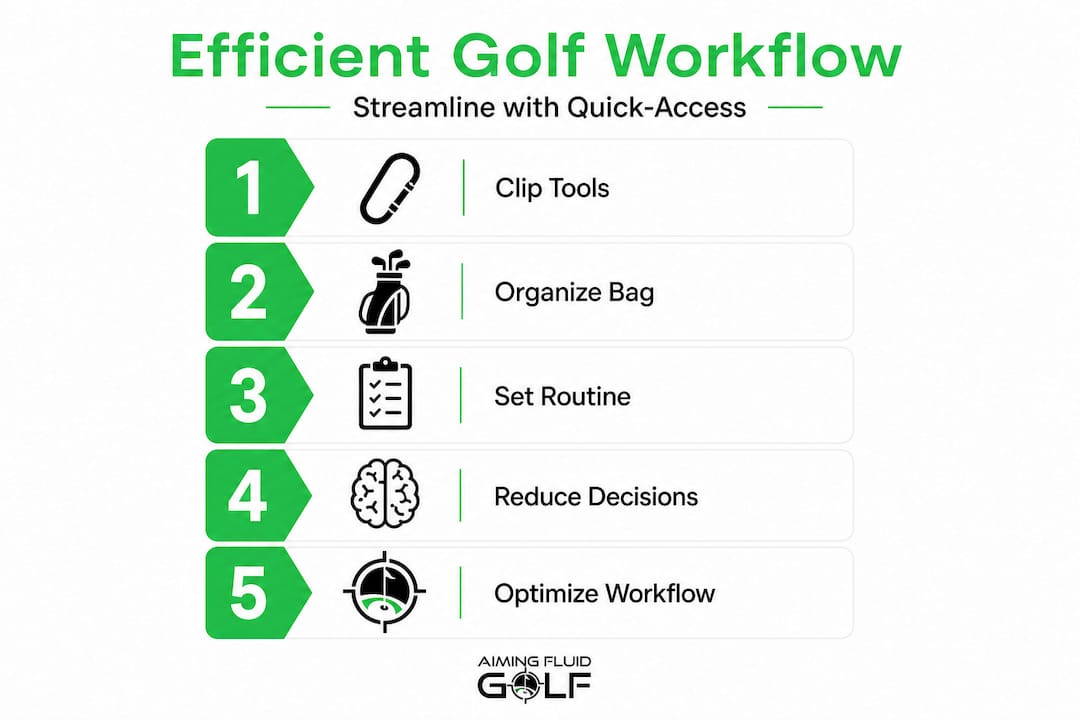
Here is a sequential process to build an effective quick-access system and maintain it:
- Audit your current bag layout. Pull everything out. Categorize tools as “quick-access” (used every hole or multiple times per round) versus “occasional use” (range finders, extra balls, rain gear).
- Assign fixed positions for quick-access items. Magnetic clip for the towel, front strap slot for the divot tool, a single small front pocket for ball markers and tees. No exceptions.
- Test and refine over three rounds. Pay attention to which positions feel awkward or cause fumbling. Adjust placement as needed.
- Commit to the system. After three rounds, stop experimenting. The goal is automatic retrieval, and that requires repetition.
- Periodic check-in every three rounds. Verify every item is still in its assigned position and the habit is holding. If something is missing or out of place, reset immediately.
Pro Tip: Create a pre-round checklist of five items: towel in place, divot tool clipped, ball markers loaded, tee holder filled, utility pouch zipped. A 30-second check before the first tee prevents scrambling on hole three.
Research on managing fatigue for peak golf performance also points to the value of reducing decision-making load during a round. Every time you have to locate a tool, you make a small decision. Multiply that across 18 holes and you generate what researchers call “decision fatigue,” a gradual erosion of cognitive performance. Systems that put tools in predictable places eliminate those micro-decisions and help preserve mental energy for the holes that matter most.
If you want to reduce gear retrieval time meaningfully, the system matters more than the individual product.
Why accessory discipline, not spending, is the true game-changer
With all the practical strategies covered, here is a candid perspective on what actually makes a difference.
There is a straightforward pattern among golfers who play efficiently and stay mentally composed throughout a round. They do not carry the most accessories. They carry the right ones, in the right places, and they return them consistently. Their bag does not look like a gear catalog. It looks deliberate.
The temptation in golf equipment culture is to assume that the next purchase will solve an organization problem. But most bag inefficiency is not a product gap. It is a habit gap. A golfer who owns a magnetic towel but leaves it loose in their bag pocket has the same retrieval problem as a golfer who uses a plain cotton towel. The mechanism is irrelevant if the behavior is not there.
Pace-of-play guidance consistently points to routine discipline as the driver of improvement, not tool adoption alone. The most organized golfers we observe use fewer tools than average but place each one precisely and retrieve it without thought.
“What sounds good in theory (buying more tools) rarely beats what works in practice: rigorous, repeatable processes.”
The compounding benefit of accessory discipline becomes visible over a full season. A golfer who returns every tool to its home position after every hole builds 1,000-plus reinforced repetitions over 18 rounds. Those repetitions convert conscious placement into automatic behavior. By mid-season, the workflow operates without effort.
That is the real performance gain. Not the tool itself, but the convenience workflow for golfers that builds around it. Start with two or three well-placed quick-access tools. Commit to the placement discipline. Let the repetitions accumulate. That approach delivers more measurable improvement than any amount of equipment spending alone.
Ready to upgrade your golf experience?
By now, you’re ready to choose the accessories that fit your routine and set yourself up for more enjoyable, efficient rounds. The difference between a scattered bag and a streamlined one is not a large investment. It is a deliberate selection of tools designed for quick access, combined with the habit discipline to use them correctly every hole.

Aiming Fluid Golf’s catalog of expert-picked golf accessories includes magnetic towels, precision tees, divot tools, and utility pouches engineered specifically for the workflows described in this article. Each product is designed to eliminate retrieval friction and support the consistent, repeatable routines that serious golfers rely on. If you want tools that match the level of intentionality you bring to your game, explore the full Don’t Suck golf gear collection and find the right fit for your bag setup.
Frequently asked questions
What is the biggest advantage of quick-access golf tools?
They minimize wasted time and distractions, allowing you to focus more on your game and less on searching for equipment. According to USGA pace-of-play research, quick-access tools help maintain pace of play and mental focus by reducing friction during recurring course micro-tasks.
Will buying premium accessories alone speed up my round?
No. Speed gains only come when tools are paired with disciplined routines and regular organization habits. The USGA notes that accessories are most effective when paired with behavior changes, not just purchase.
Which quick-access tools are most essential for regular golfers?
Magnetic towels, divot repair tools, ball markers, and tee holders are among the most-used items for improving on-course efficiency. These four tools cover the majority of recurring micro-tasks across every hole.
How should I organize my bag for best results?
Assign each quick-access tool a dedicated, visible spot and always return it there after use during your round. The USGA recommends designing your workflow so items are in the same reachable location each time, which is the foundation of an efficient round.


