


TL;DR:
- Tee height control is more important than material or design for consistent launch conditions.
- Precision tees enhance accuracy by offering repeatable height stops and low-friction impact features.
- Advanced golfers prioritize feel and predictability, while amateurs benefit most from improved setup consistency.
Choosing the right golf tee feels simple until you’re standing in front of an entire wall of options at your pro shop. Marketing claims stack up fast: low-friction designs, height-control stops, biodegradable materials, tour-proven engineering. Most golfers grab whatever’s cheapest and move on. But for players who care about consistent launch conditions and repeatable shot shape, tee selection is worth a closer look. This article breaks down the actual science behind tee performance, the real-world features that separate precision tees from standard options, and a clear framework for deciding whether switching makes sense for your game.
Table of Contents
- Understanding the science behind tee performance
- Top precision golf tee features and real-world impacts
- Comparing standard and precision tees: What’s the real difference?
- Is a precision golf tee right for you? Making the call
- The overlooked truth: Consistency trumps tech for most golfers
- Upgrade your golf game with top-rated accessories
- Frequently asked questions
Key Takeaways
| Point | Details |
|---|---|
| Tee height is critical | Research proves that consistent tee height has a greater impact on performance than tee material. |
| Features boost consistency | Low-friction designs and height markers in precision tees help amateur golfers drive smarter. |
| Pros favor basics | Professional golfers still trust standard wooden tees, showing that skill often outpaces tech upgrades. |
| Best fit for amateurs | Precision tees provide the greatest benefit to golfers with inconsistent swings or difficulty with launch control. |
Understanding the science behind tee performance
Now that we’ve set the stage for why gear like tees matters, let’s dig into what really influences tee performance.
The golf tee is the one piece of equipment you control entirely at the start of every par-4 and par-5, and most driver holes. That level of control matters because launch conditions, specifically launch angle and spin rate, are highly sensitive to tee height. Get the height wrong and you’re fighting the ball before the club even makes contact.
Golf Digest robot tests show no significant distance or accuracy difference between rubber and wooden tees at the same height, which places tee height firmly above material as the primary variable. This is a critical finding. Golfers who obsess over material are optimizing the wrong factor.
That said, tee design does influence the interaction between the club face and the ball at impact. A wide, flat cup holds the ball higher and restricts natural club movement through impact. A low-profile, tapered cup allows the club to pass through with minimal resistance, reducing the chance of the tee deflecting the ball path or introducing unwanted spin.
Reviewing golf tee selection tips helps clarify how design geometry affects launch. The cup shape, prong count, and post diameter all interact with club speed and angle of attack (AOA) to produce slightly different outcomes. These differences are small but measurable at higher swing speeds.
| Factor | Standard tee | Precision tee | Impact on outcome |
|---|---|---|---|
| Tee height | Variable | Consistent, marked | Launch angle control |
| Cup friction | Moderate | Low, tapered | Reduced gear effect |
| Material | Wood, plastic | Composite, polymer | Minimal on its own |
| Durability | Low | High | Fewer replacements |
Pro golfers tend to prioritize feel and predictability over marginal technology gains. As pro golfer tee preferences confirm, most tour players focus on consistency of height and clean breakaway rather than any friction-reduction benefit. Their skill level minimizes the impact of minor tee variables.
For most amateur golfers, the story is different. Inconsistent tee height from round to round introduces variability in launch that no swing adjustment can fully correct. That’s where precision tees for straighter drives provide a practical, measurable advantage.
“Tee height matters more than material. Get your tee height consistent before worrying about anything else.” — Golf equipment research consensus based on robot test data.
Top precision golf tee features and real-world impacts
With the science clarified, let’s look at what makes modern precision tees stand out for real golfers.
Precision tees are engineered around three core features: a low-friction cup, consistent height stops, and impact durability. Each one addresses a specific failure mode in standard tee performance.
Key features and their benefits:
- Low-friction cup design: Reduces resistance at impact, allowing the club to pass through cleanly. Less friction means less energy transferred sideways, which can tighten shot dispersion.
- Height-stop markers: Color-coded bands or rings set along the tee post indicate a specific insertion depth. Push the tee into the ground until the band sits flush with the turf and you’ve matched your preferred height every single time.
- Impact durability: Precision tees made from composite or reinforced polymer survive multiple rounds without breaking. Standard wooden tees typically last one to three shots.
- Flexible prong or reduced-contact cup: Some precision designs use flexible prongs instead of a solid cup, minimizing the contact area between tee and ball to reduce spin influence.
The tee setup for consistency becomes a repeatable pre-shot routine element when height markers are built into the tee. Instead of eyeballing the height and hoping it’s close, you use a physical reference point. That small habit change compounds over 18 holes.
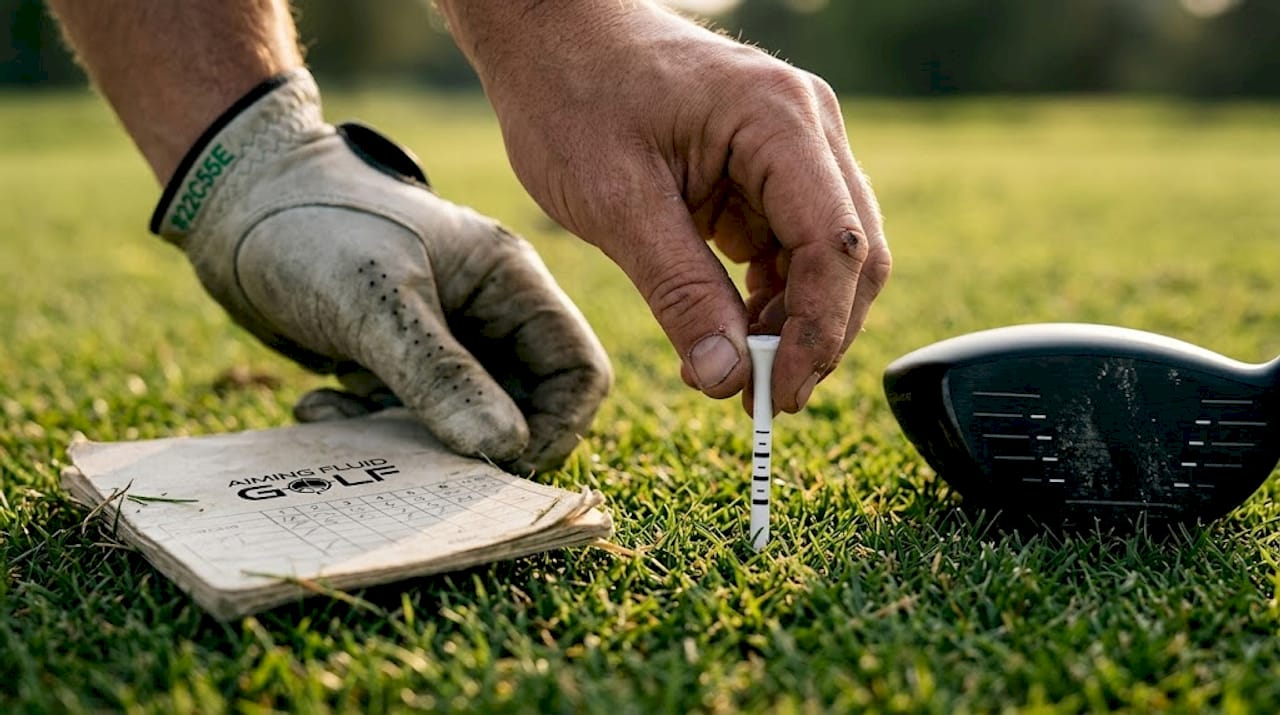
Pro Tip: Use color-coded tee bands to assign specific heights to different clubs. A red band for driver, blue for fairway wood. Your tee box routine becomes automatic, which frees up mental focus for reading the hole.
The statistical case for low-friction designs is clearest among amateur golfers with a negative angle of attack (AOA). Negative AOA golfers (most amateurs) benefit more from low-friction designs, while players with a positive AOA, typical of skilled ball-strikers, see less measurable difference. If you hit down on the ball with your driver, which most recreational golfers do, friction reduction at the tee cup is working against your natural launch mechanics.
Real-world results from how precision tees help amateurs reflect this pattern. Golfers who switch to precision tees and commit to consistent tee height often report tighter shot groupings and fewer snap hooks or pop-ups caused by tee interference at contact.
Comparing standard and precision tees: What’s the real difference?
Knowing the main features, it’s smart to see how precision options stack up against traditional tees.
Both tee types get the ball off the ground. Beyond that, the differences matter depending on your game.
Pros prefer standard wooden tees for predictable feel, clean breakaway, and course maintenance, placing skill above any marginal tee performance gain. For tour-level players, this is logical. A pro golfer’s swing mechanics are so refined that tee variation has minimal effect on outcome.
Scenarios where each tee type wins:
- High-handicap golfer with inconsistent tee height: Precision tee wins. Height markers remove one variable from an already complex swing.
- Budget-conscious golfer playing casual rounds: Standard tee wins. Cost per round stays minimal.
- Golfer focused on long-term performance improvement: Precision tee wins. Consistent setup builds better habits.
- Tour-level or scratch golfer: Standard wooden tee wins. Feel and course etiquette take priority.
- Golfer concerned about environmental impact: Precision tee wins. Reusable designs reduce plastic and wood waste per round.
| Feature | Standard tee | Precision tee |
|---|---|---|
| Height control | Manual, inconsistent | Marked stops, repeatable |
| Friction at impact | Moderate | Low, engineered cup |
| Durability | 1-3 shots | Multiple rounds |
| Cost per tee | Very low | Moderate to high upfront |
| Eco-footprint | Higher waste | Lower long-term waste |
| Feel preference | Familiar, tour-used | Modern, engineered |
Reviewing standard tee selection alongside the tee placement workflow shows that even standard tees can be used more effectively with deliberate setup habits.
Pro Tip: Carry both types. Use precision tees for driver holes where height consistency matters most, and standard wooden tees for shorter irons or when course conditions make soil penetration easier with a slimmer post.
Understanding how tee type affects performance at the mechanical level makes it easier to pick the right option for each situation rather than defaulting to one type for every shot.
Is a precision golf tee right for you? Making the call
After evaluating the options, it’s time to decide if investing in precision tees will really pay off in your game.
The honest answer is that precision tees offer the greatest return for golfers who are already working to improve but haven’t fully controlled their setup variables. If your ball-striking is inconsistent, your launch angle varies from round to round, or you’ve never deliberately matched tee height to club type, a precision tee addresses those gaps directly.
Signs a precision tee would help your game:
- You frequently hit pop-ups or low rockets off the tee with no obvious swing cause
- Your tee height varies from shot to shot because you eyeball it
- You’ve changed swing mechanics but haven’t changed setup habits
- You play more than 10 rounds per year and want a more organized tee routine
- You’re a high-handicap or mid-handicap golfer still developing consistency
The smart tee system advantages become most visible when a golfer uses them as part of a deliberate routine rather than a one-time swap. The tee is a setup tool. Using it precisely creates a reliable baseline for every swing.
Where precision tees fall short: if your fundamentals are already solid and your launch monitor data shows tight dispersion, the marginal gain from switching tees is minimal. Golf Digest robot tests confirm that material and design have minimal effect when tee height is already controlled. Skill and consistent practice outweigh equipment refinements at advanced levels.
| Decision factor | Favor precision tee | Favor standard tee |
|---|---|---|
| Handicap | 10 and above | Scratch to 5 |
| Tee height habit | Inconsistent | Deliberately controlled |
| Budget | Moderate | Minimal |
| Practice frequency | Regular | Occasional |
| Performance focus | Improving launch | Maintaining feel |
Considering golf gear ergonomics as part of your overall equipment system helps frame this decision correctly. Tees are one component of a larger setup. Improving how every piece of gear functions together produces more consistent results than isolating any single item.
The overlooked truth: Consistency trumps tech for most golfers
Once you’ve considered your options, it’s worth stepping back for a candid perspective on where true improvement in golf actually comes from.
Gear reliance is often a symptom. When a golfer switches equipment searching for lower scores, it’s frequently because the practice routine or pre-shot process hasn’t been given enough attention. The tee is a useful tool, but it doesn’t swing the club.
Pros prioritize skill over marginal tee gains, and that reflects something important: at every skill level, intentional practice beats equipment refinement. A precision tee can introduce structure to your building pre-shot routines, which is genuinely valuable. Consistent setup creates a repeatable mental and physical trigger before each shot.
But the tee doesn’t correct a casting motion, an early extension, or a tempo problem. What precision gear can do is remove variables from your setup so that when you practice, you’re practicing the swing, not compensating for inconsistent conditions. That’s the honest case for precision tees: they tighten the environment around your swing so your practice becomes cleaner. Use the technology as a framework for better habits, not as a substitute for them.
Upgrade your golf game with top-rated accessories
Ready to take the next step? Explore trusted options to elevate your gear and performance.
Precision tees are one piece of a well-organized equipment system. When your entire setup, from your tee to your towel, is designed for quick access and repeatable use, you spend less mental energy on logistics and more on playing.
Aiming Fluid Golf builds accessories that solve real on-course problems with durable, thoughtfully engineered designs. Browse the best golf accessories curated for performance and organization, explore the full premium golf tees collection, or go straight to the DON’T SUCK™ precision tees for a tee engineered around consistent height and low-friction performance. Every detail in your gear setup is an opportunity to play a more organized, focused round.
Frequently asked questions
Do precision golf tees really improve performance?
For amateur golfers, precision tees offer measurable benefits in tee height consistency and launch conditions. Negative AOA golfers see the most benefit from low-friction designs, though robot testing confirms that material alone has minimal effect when height is already controlled.
Are any specific precision tee designs preferred by pro golfers?
Most pros use standard wooden tees for their predictable feel and clean breakaway. Pros favor skill over tee technology, prioritizing course care and familiar setup over engineered design features.
Does the material of a golf tee affect ball flight?
Material has little measurable effect on ball flight when tee height is held constant. Robot tests show no significant distance or accuracy difference between rubber and wooden tees at the same height.
What golfers benefit most from precision tees?
High-handicap and inconsistent ball-strikers gain the most from precision tee features. Most amateurs with a negative angle of attack see measurable improvement from low-friction cup designs that reduce spin interference at impact.
Recommended
- Precision golf tees: drive straighter and play smarter – Aiming Fluid Golf
- Professional Wooden Golf Tees Guide: Maximize Distance & Consistency – Aiming Fluid Golf
- Step-by-step golf tee setup guide for consistency – Aiming Fluid Golf
- Why Golf Tees Affect Consistency, Launch & Dispersion | Aiming Fluid G – Aiming Fluid Golf


