


TL;DR:
- Proper tee setup significantly impacts launch angle, ball flight, and carry distance in golf.
- Follow a consistent step-by-step process for teeing up to optimize performance and accuracy.
- Investing in quality tools and fine-tuning for conditions offers a competitive edge over equipment upgrades.
Tee setup is one of the most overlooked variables in amateur golf, yet it directly controls launch angle, ball flight, and carry distance on every par-3 and tee shot you play. Robot tests show up to 25 yards lost from improper tee height alone. Most dedicated amateurs spend hundreds on new equipment while ignoring the two seconds it takes to set a tee correctly. This guide walks through every step of a proven tee setup process, from selecting the right accessories to dialing in height for your swing speed, so you can stop leaving easy yards on the table.
Table of Contents
- What you need before you tee up
- Step-by-step tee setup process explained
- Advanced tweaks: Adjusting for swing, speed, and conditions
- Common mistakes and troubleshooting
- Why tee setup is the overlooked edge in your performance
- Upgrade your game with premium tee setup tools
- Frequently asked questions
Key Takeaways
| Point | Details |
|---|---|
| Tee height matters | Proper tee positioning boosts distance and accuracy with every club. |
| Customize for your swing | Adjust tee setup based on your swing speed and club to optimize launch. |
| Routine ensures results | A consistent pre-shot tee routine delivers long-term scoring improvements. |
| Small tweaks, big gains | Minor adjustments like teeing irons or lowering for headwind create measurable performance gains. |
What you need before you tee up
Now that you understand the impact of improper tee setup, let’s make sure you have all the essentials ready before you step onto the tee box.
A consistent tee setup starts well before you pull a club. Having the right gear organized and accessible removes decision fatigue and keeps your pre-shot routine tight. If your bag feels like a junk drawer every time you reach for a tee, your mental focus is already compromised before the swing begins.
Here are the core supplies you need ready for every round:
- Driver tees: Standard length, 2.75 to 3.25 inches, for maximum height off the deck
- Fairway wood and hybrid tees: Mid-length, 1.5 to 2.25 inches, for controlled elevation
- Iron and par-3 tees: Short tees, 1.0 to 1.5 inches, for minimal ground clearance
- Golf ball: Matched to your swing speed and spin preference
- Club selection: Confirmed before you approach the tee box
- Launch monitor (optional): A portable device like Flightscope Mevo for real-time data
For quick reference, here is a gear overview table:
| Gear | Best situation |
|---|---|
| Long tee (2.75"+ ) | Driver on par-4 and par-5 holes |
| Mid tee (1.5-2.25") | Fairway woods and hybrids |
| Short tee (1.0-1.5") | Irons and par-3 shots |
| Launch monitor | Practice rounds and fitting sessions |
| Alignment sticks | Verifying stance and target line |
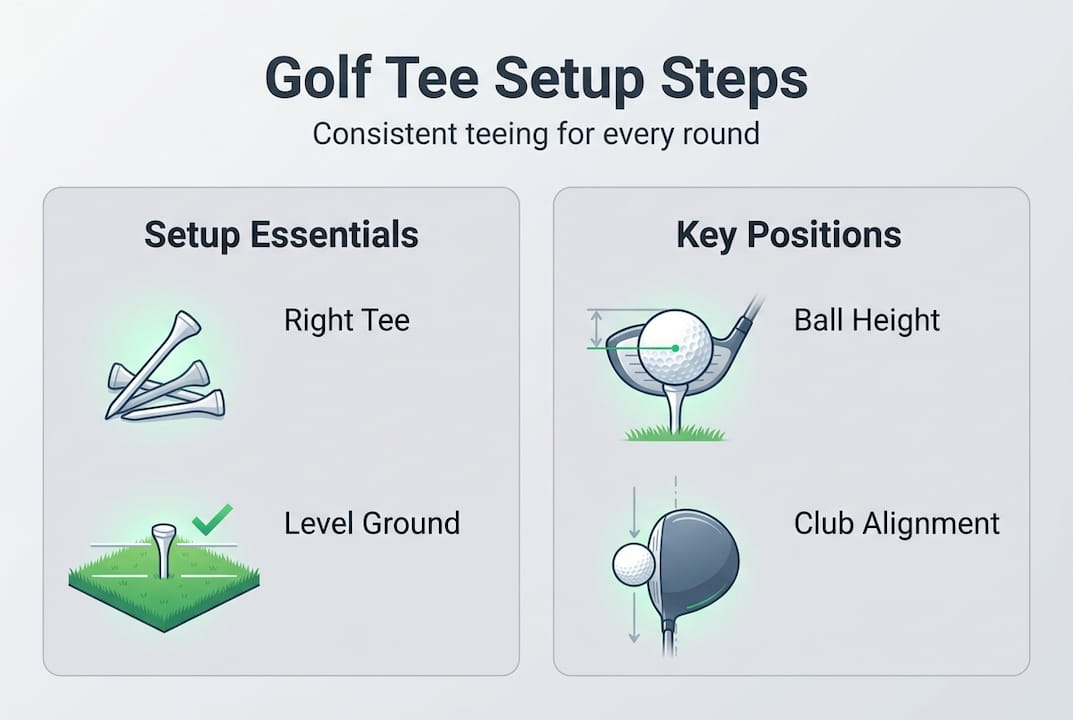
Ground selection matters just as much as gear selection. Optimal tee setup begins with choosing level ground within the teeing area, then inserting the tee at the correct height, positioning the ball forward in the stance for driver, and confirming alignment before every swing. Uneven ground shifts your weight distribution and changes your effective swing path, so take an extra moment to find a flat section within the tee markers.
Pro Tip: Before your round, sort your tees by length into separate pockets or a dedicated utility pouch. Review solid tee selection tips to match your tee inventory to your club set, and check the essential golf accessories list to make sure nothing is missing from your bag before you leave the parking lot.
Step-by-step tee setup process explained
With the right tools and setup area in place, you’re ready for the exact process. Let’s break down the steps in detail.
Following a numbered sequence removes guesswork and builds the kind of muscle memory that holds up under pressure. Here is the full process:
- Select level ground within the tee markers. Avoid divots, footprints, or any slope that tilts toward your target or away from it.
- Choose the correct tee length for the club you are hitting. Match tee length to club type using the table below.
- Insert the tee into the ground at the appropriate depth for your club. Push it firmly so it does not wobble.
- Set ball height. For driver, half to two-thirds of the ball should sit above the crown of the clubhead, with the ball’s equator level with the top edge. This promotes an upward angle of attack and maximizes carry.
- Position your ball in your stance. Driver sits off the lead heel. Fairway woods sit one ball width inside the lead heel. Irons and hybrids sit in the center to slightly forward position.
- Check alignment. Set your feet, hips, and shoulders parallel to the target line before gripping the club.
- Take your practice swing to confirm ground clearance and stance feel.
Here is a comparison table for tee height by club type:
| Club type | Tee height | Ball position |
|---|---|---|
| Driver | Half to two-thirds ball above crown | Off lead heel |
| Fairway wood | Cone visible, 1/4-1/3 ball above crown | One ball inside lead heel |
| Hybrid | Ball sits just above grass level | Center to slightly forward |
| Iron | Tee flush or just below ground level | Center of stance |
Pro Tip: Use a permanent marker to draw a line around your tee at your preferred insertion depth. This gives you a repeatable reference point every time. For a deeper look at building a consistent tee placement workflow, and to understand how precision golf tees reduce variability shot to shot, both resources are worth reviewing before your next round.
Advanced tweaks: Adjusting for swing, speed, and conditions
You’ve learned the basics. Now unlock every potential advantage by fine-tuning your tee setup for day-to-day variability.
Tee height is not a fixed number. It shifts based on your swing speed, angle of attack, and the conditions you are playing in. Treating it as a static variable is one of the most common errors among serious amateurs.
Swing speed directly determines your ideal tee height. TrackMan data shows that players swinging above 105 mph should tee the ball between 1.75 and 2.125 inches. Players in the 95 to 105 mph range perform best at 2.125 to 2.5 inches. Slower swingers below 95 mph benefit from 2.75 to 3 inches of tee height to improve launch angle and carry distance.
Conditions require their own adjustments:
- Headwind: Lower the tee to produce a penetrating, lower ball flight that cuts through the wind
- Tailwind: Raise the tee slightly to capture more carry from the favorable wind
- Firm fairways: Lower tee height to reduce spin and encourage more roll out
- Soft fairways: Higher tee to maximize carry since roll will be limited
- Cold weather: Ball compression drops, so a slightly higher tee helps maintain launch
Key stat: Improper tee height can cost you up to 25 yards of carry distance. That is the equivalent of losing a full club of distance before you even swing.
For golfers who want to maximize tee performance with data-driven decisions, portable launch monitors are now accessible at every price point. They measure ball speed, launch angle, and spin rate, giving you the exact feedback needed to verify your tee height is working. Slow-motion video from a smartphone is a free alternative that shows your angle of attack clearly.
Pro Tip: Track your tee height setting alongside your driving stats for five rounds. You will quickly spot a pattern between height adjustments and your best carry numbers. Reviewing golf tee system insights can help you build a structured approach to this tracking process.
Common mistakes and troubleshooting
Tweaking is crucial, but so is avoiding recurring missteps. Here’s how to fix the most common tee setup mistakes seen at every amateur level.
Even golfers with solid fundamentals fall into repeatable tee setup errors. Identifying your specific failure mode is the first step toward correcting it.
The four most common tee setup mistakes:
- Tee too high for irons and hybrids: Causes thin contact and ballooning ball flight. Fix: use a short tee and push it nearly flush with the ground.
- Tee too low for driver: Forces a downward angle of attack, reducing launch angle and carry. Fix: confirm half the ball sits above the crown before every driver shot.
- Ball position too far back in stance: Promotes a steep swing path and reduces distance. Fix: use a consistent reference point like your lead heel for driver setup.
- Skipping the pre-shot alignment check: Even a perfect tee height fails if your body is aimed 10 yards left. Fix: build alignment into your routine, not as an afterthought.
“Pros spend 45 to 60 seconds preparing for each shot, including their tee setup check. A consistent pre-shot routine is one of the clearest separators between amateur and professional performance.”
One underrated fix is teeing up on par-3 holes even with irons. Arccos data shows that teeing irons adds 9 to 12 yards of distance and improves clean ball contact. Most amateurs skip this out of habit, not logic.
For a full golf round prep system that incorporates tee setup into your overall routine, and to review the broader list of beginner mistakes to avoid, both resources complement what you’ve learned in this section.
Why tee setup is the overlooked edge in your performance
Most dedicated amateurs obsess over driver shaft flex, ball compression ratings, and swing plane adjustments. Very few spend deliberate time on tee setup. That imbalance is a real competitive disadvantage.
Here is the uncomfortable truth: a repeatable, process-driven tee setup delivers more consistent results than most equipment upgrades. A new driver adds potential. A correct tee height activates that potential on every single shot. Without the setup, the equipment underperforms.
The golfers who build a workflow for consistent tee placement are not spending more time on the tee box. They are spending their time more deliberately. Three to five focused seconds on tee height and ball position is not slow play. It is precision. The players who treat tee setup as a non-negotiable step in their routine are the same ones who hit fairways at a higher rate without changing their swing.
Gear matters. Swing mechanics matter. But neither reaches full potential without a sound, repeatable tee setup as the foundation.
Upgrade your game with premium tee setup tools
A sound tee setup process is only as reliable as the tools supporting it. Disorganized accessories, inconsistent tee lengths, and missing gear mid-round all break the routine you’ve worked to build.

Aiming Fluid Golf designs accessories specifically for golfers who take preparation seriously. From shop premium golf tees engineered for consistent depth and durability, to utility pouches that keep your tee selection organized and within reach, every product is built around solving real on-course problems. Pair your tee system with magnetic golf towels for instant access between shots, and browse the full best golf accessories guide to build a complete, high-performance setup.
Frequently asked questions
What is the optimal tee height for a driver?
The optimal height places the ball’s equator level with the top of the driver’s crown, with half to two-thirds of the ball sitting above the clubhead for an upward angle of attack.
How does swing speed influence tee height?
According to TrackMan swing speed data, faster swingers above 105 mph use lower tee heights around 1.75 to 2.125 inches, while slower swingers below 95 mph benefit from higher settings of 2.75 to 3 inches for better launch.
Does teeing up an iron really make a difference?
Yes. Arccos data confirms that teeing irons adds 9 to 12 yards of distance and promotes cleaner contact, so always tee up when the rules of play allow it.
How do I adjust tee setup for wind conditions?
Lower the tee in a headwind for a penetrating ball flight that cuts through resistance, and raise it slightly in a tailwind or on soft fairways to maximize carry distance.
How long should a proper tee setup routine take?
PGA pros average 45 to 60 seconds of preparation per shot, including their tee height check, which is the standard to model your own pre-shot routine around.
Recommended
- Master golf tee placement workflow for consistent drives – Aiming Fluid Golf
- Professional Wooden Golf Tees Guide: Maximize Distance & Consistency – Aiming Fluid Golf
- Why Golf Tees Affect Consistency, Launch & Dispersion | Aiming Fluid G – Aiming Fluid Golf
- Golf tee selection tips to improve your game performance – Aiming Fluid Golf
Make your golf tee setup easier to repeat
Use the same 2 3/4-inch performance golf tees, keep the driver face and golf ball clean, and store the essentials in a predictable place. A repeatable tee-box routine is easier when the equipment does not change from shot to shot.
Best starting setup: PureFlight™ four-prong golf tees plus the compact Stubby magnetic golf towel for clean contact during practice and play.
Aiming Fluid Golf designs and sells the products in this recommendation. The original article and all of its cited links remain unchanged above.


