


TL;DR:
- Hybrid golf tees reduce ball-tee contact resistance, resulting in more consistent launches.
- They are more durable and last longer than traditional wooden or plastic tees.
- Cost and environmental impact vary; testing and matching tee size to clubs optimize performance.
Most golfers assume a tee is just a tee. You push it into the ground, set the ball, and swing. But that assumption costs you consistency on every drive. Hybrid golf tees work on a fundamentally different principle than the wood or plastic tees sitting in your bag right now. They reduce contact between the ball and the tee itself, which changes how the ball launches off the clubface. This article covers exactly what hybrid tees are, how they compare to traditional options, their real advantages and drawbacks, and practical tips for getting the most from them.
Table of Contents
- What are hybrid golf tees?
- How hybrid tees differ from wood and plastic
- Pros and cons of hybrid golf tees
- Who benefits from hybrid tees and tips for using them
- Why hybrid golf tees are the most misunderstood accessory
- Discover top-rated golf tees and accessories
- Frequently asked questions
Key Takeaways
| Point | Details |
|---|---|
| Hybrid design advantage | Hybrid tees combine plastic and nylon bristles for more consistent ball support and longer tee life. |
| Performance vs tradition | They offer greater durability and launch consistency, though some golfers prefer classic wood for feel and eco reasons. |
| Smart fit matters | Selecting the right size hybrid tee based on your club improves results on the course. |
| Experimentation works | Trying different tees is the best way to find what boosts your game and suits your style. |
What are hybrid golf tees?
The term “hybrid” in golf equipment usually signals a combination of materials or design philosophies. In tees, that definition holds.
This design matters because of a concept called tee resistance. When a clubhead strikes a ball sitting on a rigid tee, the tee itself creates a small but measurable friction point. Bristle-based hybrid tees minimize that resistance, allowing the ball to leave the tee with less interference. The result is a cleaner, more repeatable launch angle.
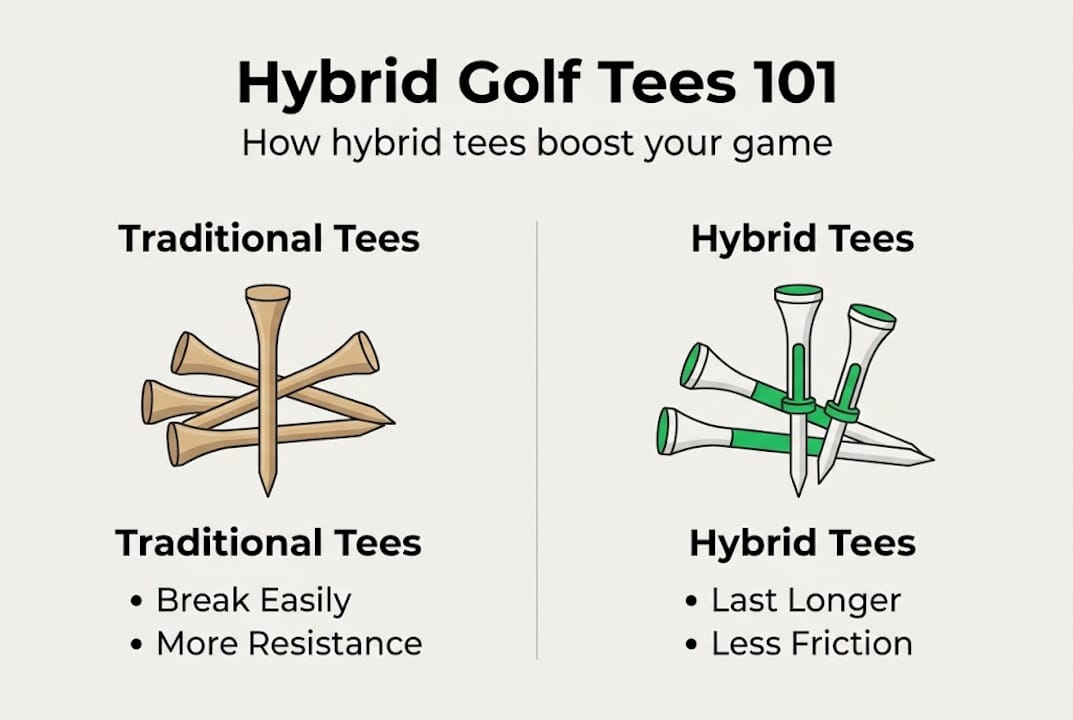
Hybrid tees are available in multiple sizes to match different clubs and swing types:
| Tee size | Best for |
|---|---|
| 2.0 inch | Fairway woods and hybrids |
| 2.2 inch | Standard drivers |
| 2.4 inch | Oversize drivers |
| 1.5 inch | Irons and low-profile shots |
For golfers exploring golf tee selection tips, matching tee height to club type is one of the most overlooked variables in driving consistency. Hybrid tees make this easier because the bristle cup holds the ball at a fixed height without requiring you to adjust how deep you push the stem.
Key design features of hybrid tees include:
- Plastic stem: Durable, flexible, and resistant to snapping under normal swing force
- Nylon bristle cup: Reduces ball-to-tee contact surface area significantly
- Fixed height mechanism: Ball sits at a consistent height every time
- Multi-use design: Most hybrid tees survive dozens of shots before showing wear
Understanding golf tee systems as a whole helps put hybrid tees in context. They are not a novelty. They represent a specific engineering approach to reducing variables at the moment of impact.
How hybrid tees differ from wood and plastic
Understanding the makeup of hybrid tees sets up a natural comparison: here’s how they stack against tradition.
Wooden tees are the oldest and most familiar format. They are biodegradable, inexpensive, and widely available. The problem is consistency. Wood tees break frequently, and even when they don’t break, the ball sits on a solid cup that creates drag at impact. Plastic tees improved on durability but kept the same rigid contact point. Neither format addresses the friction issue at the core of tee performance.
Hybrid tees solve that problem with flexible bristles. Here is a direct comparison across the key variables:
| Feature | Hybrid tee | Plastic tee | Wooden tee |
|---|---|---|---|
| Material | Plastic stem + nylon bristles | Solid plastic | Wood |
| Durability | High (multi-round use) | Medium | Low (breaks often) |
| Ball contact | Minimal (bristle support) | Solid cup | Solid cup |
| Eco-friendliness | Low | Low | High |
| Cost per tee | High upfront | Low | Very low |
| Consistency | High | Medium | Variable |
Hybrid tees are more durable than both wood and plastic but come with a higher upfront cost. Over a full season, the cost-per-shot calculation often favors hybrids because a single tee can last an entire round or more.
For golfers who want to understand how wood performs, the wooden golf tees guide breaks down the specific strengths of that format. Wood still has its place, particularly for golfers who prioritize environmental impact or who simply prefer the feel.
Pro Tip: If you switch from wood to hybrid tees, give yourself five to ten rounds to calibrate. The reduced tee resistance can produce a slightly different ball flight initially, especially if you have been compensating for tee drag in your swing without realizing it.
For drivers specifically, why tees affect launch is worth understanding before making a switch. The interaction between tee height, ball position, and contact surface all influence dispersion patterns. Hybrid tees reduce one variable. That alone can tighten your shot groupings over time. Golfers focused on precision golf tees as a performance category will find hybrids fit naturally into that framework.
Pros and cons of hybrid golf tees
Knowing the differences, let’s get specific about the pros, cons, and whether hybrid tees might fit your style.
Advantages of hybrid tees:
- Consistent ball height: The bristle cup holds the ball at the same height on every shot without adjustment
- Reduced tee resistance: Less contact between ball and tee means a cleaner energy transfer at impact
- Long lifespan: Most hybrid tees survive multiple rounds, reducing how often you replace them
- Less distraction: You spend less time re-teeing after broken tees or adjusting height
- Improved launch repeatability: Golfers focused on precision and straighter drives benefit from the reduced friction at impact
Disadvantages of hybrid tees:
- Higher upfront cost: A pack of hybrid tees costs significantly more than a bag of wood or plastic tees
- Not biodegradable: Plastic and nylon materials do not break down naturally, which matters to environmentally conscious golfers
- Feel difference: Some golfers find the bristle cup feels unfamiliar and prefer the solid contact of traditional tees
- Overkill for casual rounds: If you play once a month and don’t track performance data, the investment may not feel justified
“Hybrid tees are preferred for performance by some, but not by golfers who value tradition or maximum eco-friendliness.”
User feedback on hybrid tees splits along predictable lines. Competitive golfers and those who track their driving statistics tend to report genuine improvement in consistency. Recreational golfers who play for enjoyment rather than score improvement often find the cost hard to justify. Neither group is wrong. The tee type that works best depends on what you are optimizing for.
For golfers who want data-backed guidance, golf tee performance tips cover how to evaluate tee performance across different swing speeds and club types. Matching your gear to your actual game, rather than to what a pro uses, produces better results.
Who benefits from hybrid tees and tips for using them
With all these factors in mind, here’s how to decide if hybrids are right for you and ensure you’re using them effectively.
Hybrid tees deliver the most value to golfers who:
- Hit the driver frequently and want consistent launch height on every shot
- Track performance metrics like driving distance, fairways hit, or dispersion width
- Play multiple rounds per week and go through traditional tees quickly
- Have already optimized other parts of their game and want to reduce remaining variables
For casual players who tee off a few times per month, wood or plastic tees remain practical and cost-effective. There is no performance gap large enough to justify the cost difference if consistency is not a priority.
How to use hybrid tees effectively:
- Match size to club. Hybrid tees are available in sizes to match club height: 2" for fairway woods and 2.4" for oversize drivers. Using the wrong size defeats the fixed-height benefit.
- Push the stem to the same depth each time. Even though the bristle cup standardizes ball height, inconsistent stem depth can shift the effective tee height. Use a consistent push-in technique.
- Inspect bristles after each round. Splayed or bent bristles reduce the tee’s ability to hold the ball at the correct height. Replace the tee when bristles no longer return to an upright position.
- Use a golf tee setup guide to calibrate your routine. Consistent tee setup is as important as the tee itself.
- Test on the range before a round. Switching tee types mid-round without prior practice can disrupt your rhythm. Spend a session on the range with hybrid tees before bringing them into competition.
Pro Tip: For golfers building a tee placement workflow, hybrid tees simplify the height-setting step. You push, the bristles hold the ball, and you swing. Fewer decisions at the tee box means more mental bandwidth for shot execution.
Traditional tees still make sense in certain situations: par-3 holes where you tee an iron, casual rounds where you are not tracking performance, or any context where environmental impact is a priority.
Why hybrid golf tees are the most misunderstood accessory
The debate around hybrid tees is not really about performance. It is about identity. Golf has a long tradition of specific rituals, and the wooden tee is one of them. Golfers who resist hybrid tees often do so not because they have tested them and found them lacking, but because change in golf equipment feels like a departure from something that matters.
That is a legitimate feeling. But it is worth separating tradition from performance when making gear decisions. Hybrid tees offer measurable gains in consistency for golfers who are willing to test them objectively. The bristle design is not a gimmick. It is an engineering solution to a real problem: rigid tee contact creates a variable that most golfers never account for.
The eco-friendliness argument is also worth examining honestly. Wood tees are biodegradable, but they break constantly, meaning you use more of them per round. A hybrid tee that lasts a full season may have a lower total material footprint than 200 wood tees. That calculation is not definitive, but it complicates the simple narrative.
The smartest approach is to treat tee selection the same way you treat any performance-focused golf gear decision: test it, measure the result, and choose based on your data rather than convention.
Discover top-rated golf tees and accessories
If you’ve been playing with the same tees for years without questioning whether they’re serving your game, now is a good time to reassess. Hybrid tees represent one category of a broader shift toward performance-engineered golf accessories that reduce variables and improve consistency.

Aiming Fluid Golf carries a curated selection of shop golf tees designed for golfers who take equipment decisions seriously. Whether you’re ready to try hybrid tees or want to compare options across formats, the collection covers the full range. For a broader look at gear that improves your on-course efficiency, the best golf accessories guide is a practical starting point. The right tee is one piece of a well-organized system.
Frequently asked questions
What are hybrid golf tees made of?
Hybrid golf tees feature a plastic stem and a nylon bristle or flexible cup that supports the ball at a consistent height above the ground.
Are hybrid tees legal for tournament play?
Most hybrid tees are legal under USGA rules as long as the design does not exceed the maximum tee height restriction or provide an additional alignment advantage beyond what the rules permit.
Do hybrid golf tees really improve performance?
Many golfers report improved launch consistency and longer tee life after switching, though some players prefer traditional formats based on feel and play style.
How do I pick the right size hybrid tee?
Select your size based on the club you’re teeing: 2" for fairway woods, 2.2" for standard drivers, and 2.4" for oversize drivers to achieve the correct ball height at address.
Recommended
- What is a golf tee system? Boost your game with smart tee solutions – Aiming Fluid Golf
- Precision golf tees: drive straighter and play smarter – Aiming Fluid Golf
- Golf tee selection tips to improve your game performance – Aiming Fluid Golf
- Professional Wooden Golf Tees Guide: Maximize Distance & Consistency – Aiming Fluid Golf


