


TL;DR:
- Futureproof golf gear combines AI tracking, modular design, and durable materials to adapt as your game evolves. Integrating technology with organized storage systems creates a seamless setup that enhances performance and reduces on-course friction. Building a system-minded kit through deliberate upgrades maximizes efficiency and continuous improvement over time.
You have gadgets in your bag that you barely use, a rangefinder that only tells you yardage, and no clear picture of where your game is actually breaking down. This is a familiar frustration for regular golfers who have invested in equipment but still feel like their setup works against them on the course. The concept of futureproof golf gear changes that equation by combining AI-powered tracking, modular storage design, and integrated accessories into setups that adapt to your game rather than complicating it. This article breaks down the tech, the organization systems, and the practical steps for building a kit that genuinely performs.
Table of Contents
- What makes golf gear ‘futureproof’?
- Revolutionary tracking and performance tech
- Game-changing organization: smart bags and modular storage
- Action plan: How to futureproof your golf kit
- Why most golfers are missing the ‘system’ mindset
- Find your next futureproof golf upgrade
- Frequently asked questions
Key Takeaways
| Point | Details |
|---|---|
| Futureproof means integration | Gear that leverages smart tech and modular designs stays relevant as needs evolve. |
| Smart trackers are game changers | AI-driven shot tracking and personalized coaching noticeably boost performance and efficiency. |
| Organization equals efficiency | Modern bags with multi-pocket, accessible layouts remove hassle and keep focus on play. |
| Upgrade with a system in mind | Best results come from coordinated equipment decisions, not single gadgets. |
What makes golf gear ‘futureproof’?
The word “futureproof” gets used loosely in consumer markets, but in golf equipment it has a precise meaning. Futureproof gear is designed to remain relevant and functional as the game evolves, either because it integrates emerging technology, supports modular upgrades, or is built with longevity-grade materials that do not degrade quickly with regular use.
The shift toward smart design golf accessories reflects a broader trend in the equipment industry: golfers want gear that works as a system, not as a collection of isolated tools. A futureproof setup typically has four defining characteristics:
- Tech integration: The gear connects to software, apps, or sensors that extend its usefulness beyond a single function.
- Modular adaptability: Components can be upgraded, replaced, or reconfigured without replacing the entire setup.
- Longevity by design: Materials and construction standards are chosen for durability under repeated use, not just initial performance.
- Data continuity: The gear collects or supports data that improves over time as more rounds are logged.
“The real value of futureproof gear is not what it does on day one. It is what it learns, adapts to, and enables as your game changes across seasons.”
A clear example of this trajectory is the Arccos Air, a pocket-sized wearable device that auto-tracks every shot using AI, a gyroscope, accelerometer, and GPS, without requiring physical sensors on clubs or active phone interaction. That kind of passive, accurate data collection was not practical five years ago. It is now standard in the futureproof category.
The integrated golf system examples that perform best share one trait: every component supports every other component. Your tracking device informs your club selection. Your bag layout keeps your most-used tools accessible. Your accessories eliminate friction at every transition. That coordinated approach is what separates a futureproof setup from a bag full of individual gadgets.
With the importance of innovation established, let’s break down the most impactful categories of futureproof golf gear.
Revolutionary tracking and performance tech
Tracking technology has moved well past simple GPS yardage. Modern performance devices collect, analyze, and apply data in real time, giving regular golfers access to insights that were previously reserved for professionals with full-time coaching staff.
Shot trackers represent the most accessible entry point. The Arccos Air auto-logs every swing automatically and benchmarks your performance against a database of 1.5 billion tracked shots using embedded AI. There is no manual input, no club tagging required, and no disruption to your pre-shot routine. The system identifies patterns across rounds, including which clubs you overestimate, which distances cause the most dispersion, and how your performance shifts under pressure conditions like tight fairways or elevated greens.
Smart balls operate at a different level of granularity. The GENIUS smart golf ball captures putting metrics including velocity, launch angle, side spin, skid, and roll using embedded sensors, then delivers feedback through a companion app. The ball is regulation size and weight, so its data is collected under real playing conditions. For golfers working on putting consistency, this is a fundamentally different feedback mechanism than video review alone.
Intelligent clubs take the concept further. The G-GRIP Pro 7-iron contains embedded sensors and an AI coaching engine that analyzes your swing after just 10 repetitions and delivers personalized coaching via Bluetooth to your phone or watch. The implications for range sessions are significant: you get targeted, individualized feedback without scheduling a lesson or relying on subjective self-assessment.
Smart rangefinders have also evolved beyond basic slope compensation. The Arccos Smart Laser adjusts Plays Like distance for slope, wind, temperature, humidity, and altitude simultaneously, then layers in AI-generated club recommendations drawn from 1.5 billion shots. The result is a yardage number that accounts for your actual environment, not just the straight-line distance to the flag.
The performance impact of these tools on real golfers is measurable. Arccos users gained an average of 5.02 strokes in their first year of use, with 98% shot tracking accuracy across all club types.
| Device type | Core function | Key benefit | Primary limitation |
|---|---|---|---|
| Arccos Air shot tracker | Auto-logs every swing via AI + GPS | Passive tracking, no manual input | Limited short putt/chip accuracy |
| GENIUS smart ball | Captures putting metrics via sensors | Granular roll and spin feedback | Requires regulation-approved use check |
| G-GRIP Pro 7-iron | AI swing analysis via embedded sensors | Personalized coaching after 10 swings | Single-club format |
| Arccos Smart Laser | Multi-factor Plays Like distance | Real-time environmental adjustments | Premium price point |
Pro Tip: Prioritize full-swing tracking data first. Shot trackers excel at identifying distance and dispersion patterns across your full set. Short chip and putt metrics, while useful, typically show their value only after several weeks of trend accumulation. Build your data foundation from the full swing outward.
You can explore dedicated options through Arccos tracking sensors and pair data insights with physical technique work using a golf swing trainer.
Having seen the transformation in data and coaching, organization is the next piece of the futureproof puzzle.
Game-changing organization: smart bags and modular storage
Technology without organization creates a different kind of friction. You can have the best tracking device available, but if your bag slows you down between shots, the net effect on pace of play and mental focus is negative. Futureproof gear applies the same design logic to physical storage that AI applies to data.
Modern golf bags built around organizational efficiency move away from the traditional two-pocket, dump-everything design. The Kolf Maison Paganica stand bag is a concrete reference point here: it offers 15 dedicated storage zones, including 7 external and 8 internal pockets, velvet-lined dividers to protect club shafts and grips, and a cart strap pass-through that keeps the bag accessible on both walking and riding rounds. That level of zoning eliminates the “junk drawer” problem that affects most amateur setups.
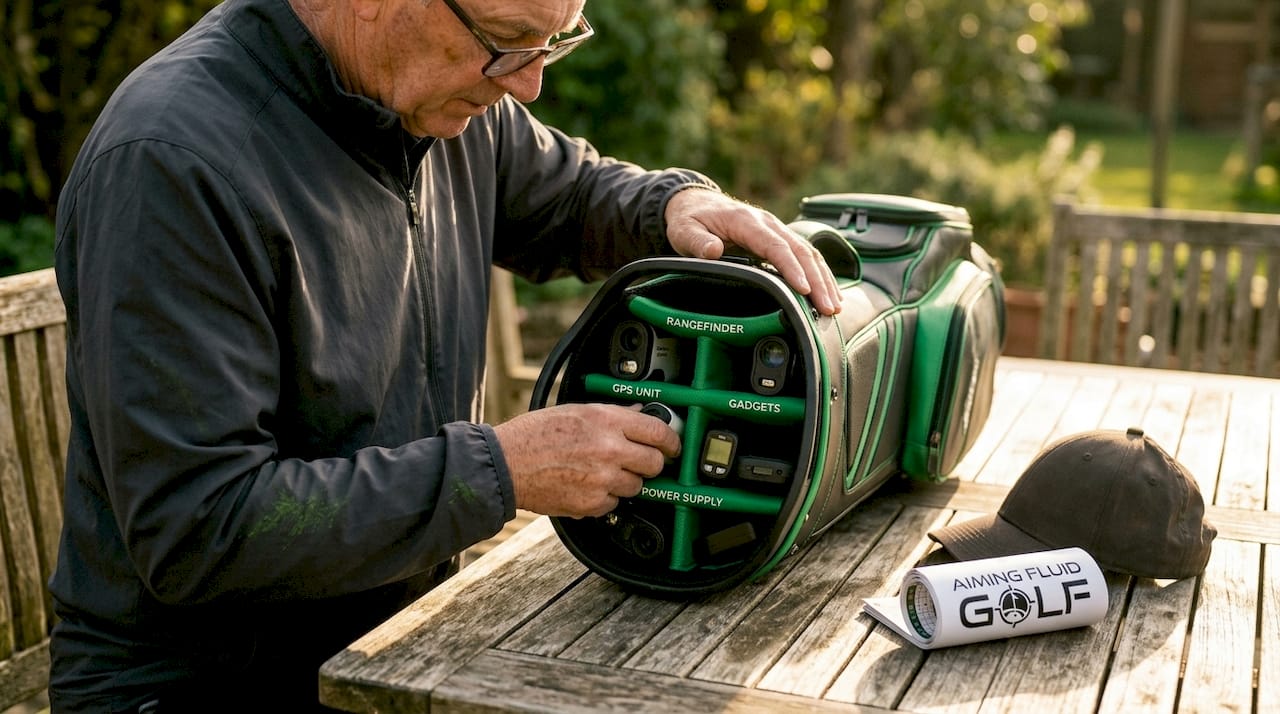
The practical benefit is that you stop making micro-decisions under pressure. When your tees, ball marker, divot tool, and rangefinder each have a fixed location, retrieval becomes automatic. You arrive at your ball already focused on the shot, not searching through pockets.
When evaluating any bag for futureproof credentials, prioritize these features:
- 14-way full-length dividers that separate every club and prevent tangling during transit.
- Dedicated external access pockets for frequently used items like tees, balls, and accessories.
- Soft, non-abrasive lining in club storage areas to protect shafts and grips over time.
- Integrated cart compatibility so the bag functions equally well in a riding cart or on a stand.
- Modular attachment points for add-on pouches, towels, or accessories that expand storage without increasing bag bulk.
Understanding how to organize your golf bag by usage frequency and physical weight distribution is the structural foundation. A 14-way cart bag review provides a detailed look at how full-length divider systems perform under actual round conditions.
| Bag design | Storage zones | Weight | Key organizational feature |
|---|---|---|---|
| Kolf Maison Paganica | 15 zones (7 ext / 8 int) | Premium carry | Velvet dividers, cart pass-through |
| 14-way cart bag | 9+ pockets | Cart optimized | Full-length club dividers |
| Anyday lightweight stand | 14-way | Ultralight carry | Integrated cooler pocket |
The Anyday Bag review covers the lightweight end of this spectrum, showing how a 14-way stand bag with a built-in cooler pocket functions across walking rounds without sacrificing organizational capacity.
Now, let’s clarify how you can prioritize your own gear upgrades for maximum return on the course.
Action plan: How to futureproof your golf kit
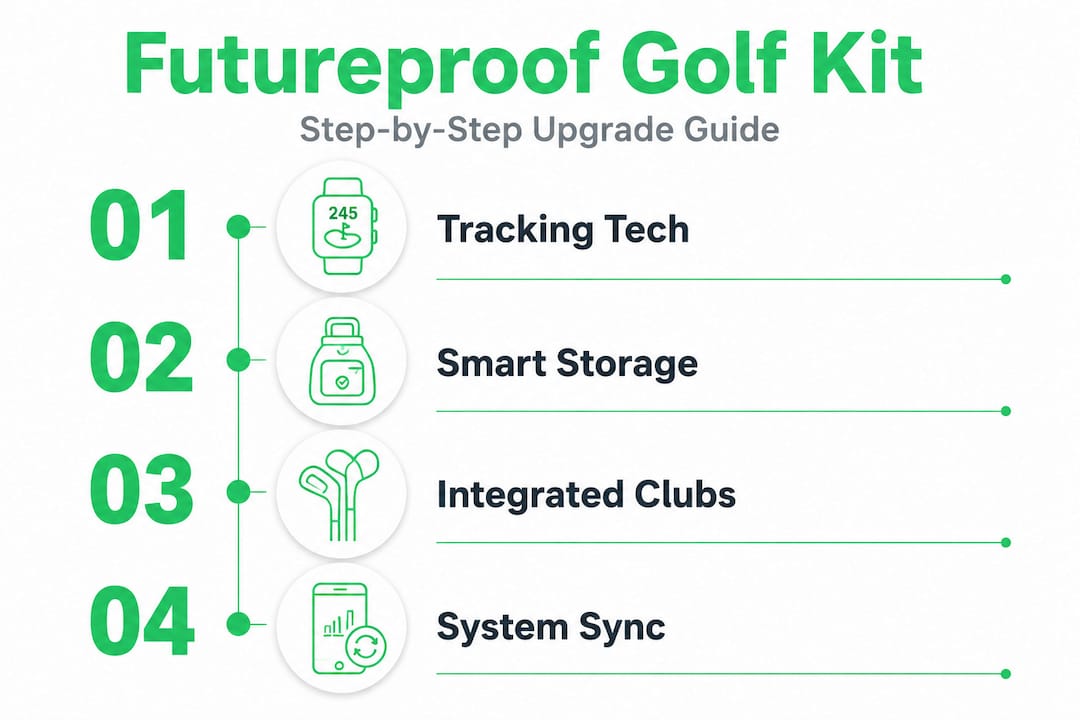
Building a futureproof setup is not about buying everything at once. It is about sequencing upgrades so that each addition reinforces the others. The following process is designed to minimize wasted spending and maximize compounding efficiency gains.
-
Audit your current kit. Identify which items you use every round versus which ones you carry habitually. If you cannot name the last time you used something, it is dead weight. Remove it before adding anything new.
-
Establish your primary data gap. Are you losing strokes on full-swing dispersion, putting lag, or club selection errors? Your first tech upgrade should target the largest measurable gap, not the most expensive device on the market.
-
Select a shot tracker as your data foundation. An AI-powered device like Arccos Air provides data-driven efficiency by auto-tracking shots and recommending clubs, replacing the guesswork that manual scorekeeping leaves in place. It handles full swings accurately and builds a statistical profile of your game that gets more precise with every round.
-
Upgrade your bag to match your tracking workflow. Your tech is only useful if your physical setup allows you to act on it. Choose a bag with dedicated zones for your tracker, rangefinder, and frequently accessed accessories.
-
Add modular accessories to eliminate remaining friction points. Magnetic towels, utility pouches, and precision tees each solve specific micro-problems. Address one friction point at a time with solutions that integrate cleanly into your existing layout.
-
Review your data after 10 rounds. Look for patterns that repeat. If your 6-iron dispersion is consistently right of target, that is actionable. If you are losing strokes on second shots from 150 to 175 yards, that is a specific practice focus.
Pro Tip: Upgrade one category at a time, starting with either tracking or storage depending on your most acute frustration. Test that upgrade across at least 5 rounds before adding the next layer. Stacking upgrades simultaneously makes it impossible to measure what is actually producing improvement.
Understanding the connection between quality golf gear gains and golf gear ergonomics helps clarify why physical design and performance data work together rather than independently. The full golf equipment system framework connects these elements into a single coherent model.
Before wrapping up, it is worth considering what most articles on the topic tend to miss.
Why most golfers are missing the ‘system’ mindset
The most common pattern in golf equipment decisions is reactive purchasing. A golfer sees a new device reviewed well, buys it, uses it inconsistently, and moves on to the next thing without ever measuring the result. The bag accumulates layers of gear that share no logical relationship with each other.
The actual edge in modern golf equipment is not any single device. It is what happens when your tracking data, storage system, and on-course accessories operate as one coordinated golf equipment system approach. A shot tracker that tells you your 7-iron average carry is 152 yards is useful. A bag organized so your 7-iron is always in the same slot, retrieved without looking, while your rangefinder is clipped to an external pocket and your yardage data is already on your watch, is genuinely transformative.
Most golfers treat gear upgrades as vertical additions. Buy better clubs, buy a better tracker, buy a better bag, independently of each other. The system-minded golfer treats every addition as a horizontal integration. How does this new piece connect to what I already have? Does it reduce friction or add it? Does it give me data I can act on, or data I will ignore because my routine does not support using it?
This is the undervalued edge for the regular golfer seeking consistent improvement. The technology exists. The organizational tools exist. The missing variable is the deliberate design of a setup where every component makes every other component more effective. That mindset shift is worth more than any single product purchase.
Find your next futureproof golf upgrade
Putting a futureproof setup together requires vetted information on what products actually perform at the level their specs promise. Aiming Fluid Golf provides detailed reviews, comparisons, and curated recommendations across every category covered in this article.

Explore top golf accessory picks for a curated breakdown of cart and carry accessories tested for real-round performance. If you are evaluating stand bag options, the 5-way stand bag review covers tour-grade features in a lightweight carry format. For the specific problem of towel accessibility and cleanliness between shots, the magnetic golf towels collection addresses it with a system designed to keep your towel instantly accessible every time without digging through your bag.
Frequently asked questions
What is the best way to track golf shots automatically?
The most reliable option is a dedicated AI-powered tracker like Arccos Air, which auto-logs shots using a gyroscope, accelerometer, and GPS without requiring phone input or club sensors. It operates passively throughout the round.
Are smart golf balls worth it for putting data?
Smart balls like GENIUS provide detailed feedback on putting mechanics including velocity, side spin, and skid, but their primary value emerges from tracking mechanical trends across multiple sessions rather than single-round feedback.
What features should a futureproof golf bag have?
Look for 14 to 15 storage zones, easy-access external pockets, soft club dividers, and modular attachment options. The Kolf Maison Paganica stand bag provides 15 zones with velvet dividers and a cart strap pass-through as a practical reference point.
Can smart rangefinders really make a scoring difference?
Smart rangefinders that adjust Plays Like distance for slope, wind, temperature, humidity, and altitude give you a far more accurate number than raw yardage, reducing the guesswork that leads to wrong club selection and avoidable bogeys.
How much can regular golfers actually improve with these devices?
Arccos users gained an average of 5.02 strokes in their first year of use, with 98% shot tracking accuracy, representing a measurable improvement that outpaces most swing instruction programs over the same period.
Recommended
- Boost your game: must-have modular golf gear for efficient play – Aiming Fluid Golf
- Functional golf equipment meaning: boost organization in 2026 – Aiming Fluid Golf
- Quality golf gear: 15 yards more distance in 2026 – Aiming Fluid Golf
- Master on-course gear management for peak golf performance – Aiming Fluid Golf


