


TL;DR:
- Efficient golf gear management involves organizing, maintaining, and structuring equipment to enhance on-course efficiency. Clear categorization and regular resets improve retrieval speed, protect accessories, and support focused play. Modular systems and proper storage routines extend gear lifespan and simplify setup for different courses.
Efficient gear management is the deliberate process of organizing, maintaining, and preparing golf equipment and accessories to maximize on-course efficiency and minimize time wasted searching for items. Golfers who apply structured gear management strategies retrieve equipment faster, protect premium accessories from damage, and maintain sharper focus during every round. This guide covers the core principles: categorization, storage systems, maintenance routines, and practical on-course application. Aimingfluidgolf builds its entire product line around these principles, designing accessories that make the system work without extra effort.
What is efficient gear management for golfers?
Efficient gear management is the practice of organizing golf equipment by function, maintaining it consistently, and structuring your bag so every item is exactly where you expect it. The industry term for this discipline is gear organization and load management, a framework used across performance sports to reduce retrieval time and mental load during competition.
The core benefit is speed. Categorizing equipment by function allows golfers to find items 50–70% faster in high-pressure situations by eliminating unorganized piles. That speed compounds across 18 holes. Every second you spend digging through your bag is a second your focus drifts from the shot ahead.
Gear management also protects your investment. Premium golf accessories, including magnetic towels, precision tees, and divot tools, degrade faster when stored loosely or exposed to moisture. A structured system keeps gear clean, dry, and ready. Aimingfluidgolf designs products specifically to support this kind of system, where every accessory has a defined place and a defined purpose.
How to categorize and organize golf gear effectively
Categorization is the foundation of any gear management system. The goal is to group items so that retrieval requires zero mental effort. You should never have to think about where something is.
The most effective method groups gear into four functional categories:
- Playing essentials: Golf balls, tees, ball markers, and gloves. These go in the most accessible pocket of your bag, front and center.
- Maintenance tools: Divot tools, groove cleaners, and towels. These need to be reachable mid-round without stopping or unzipping multiple pockets.
- Course navigation: Rangefinders, scorecards, and pencils. Group these together so pre-shot routine stays consistent.
- Backup and protection: Spare balls, rain gear, sunscreen, and snacks. These live in the lower or rear compartments where bulk does not interfere with quick access.
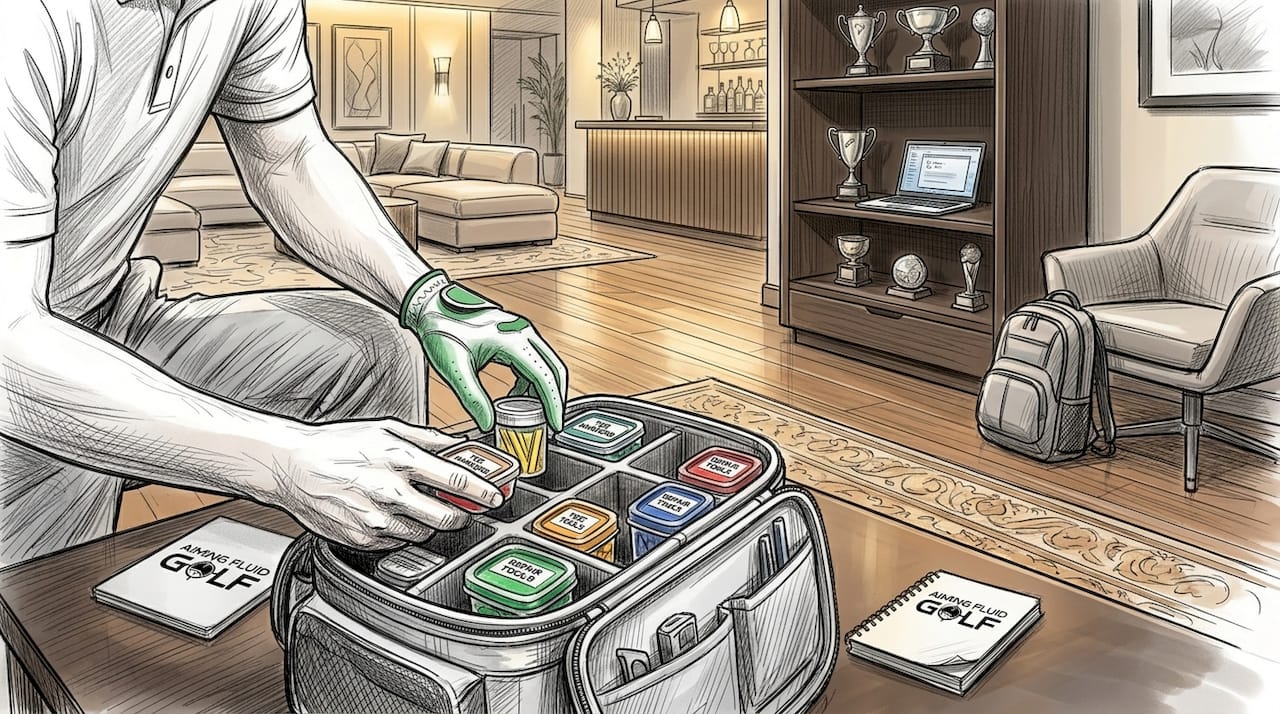
Color-coded labels and clear containers are the standard method for visual identification in high-performance gear systems. Apply the same logic to your bag pockets. A red pouch for maintenance tools and a blue pouch for navigation items means your hand goes to the right place automatically.
Vague categorization is the most common failure mode in gear organization. A pocket labeled “miscellaneous” becomes a junk drawer within two rounds. Specific groupings reduce the mental effort required every time you reach into your bag.
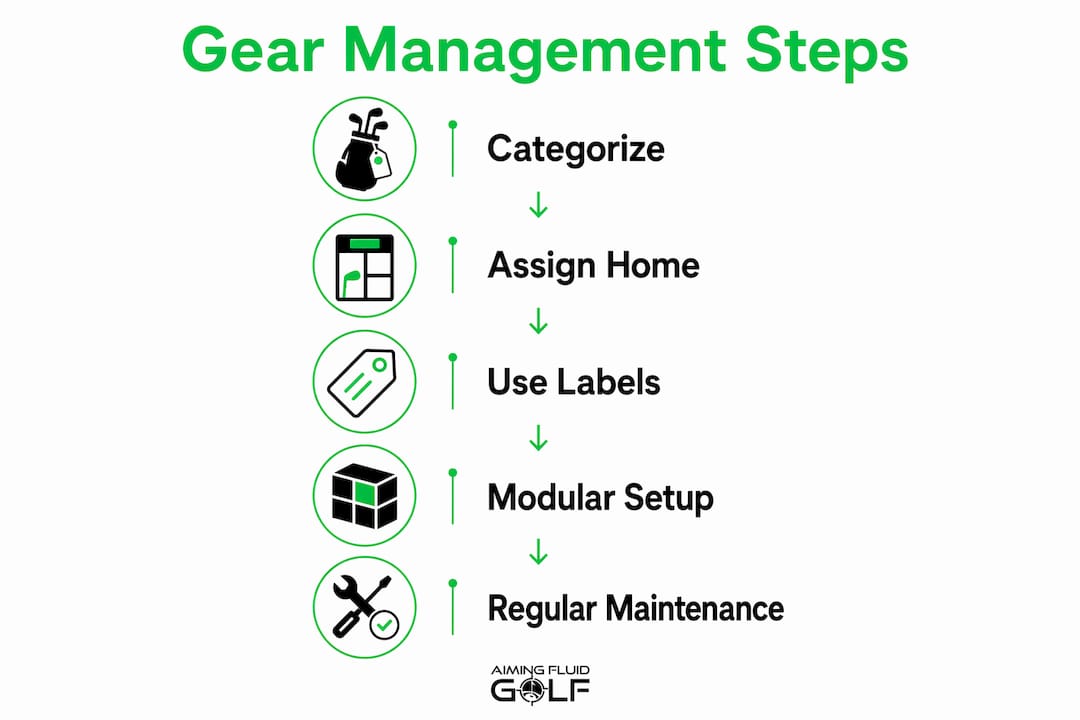
Pro Tip: Assign every item a home before your first round with a new system. If an item does not have a clear category, ask whether it belongs in the bag at all.
Modular organization systems outperform fixed layouts because they adapt to different courses and conditions. Modular, customized gear systems tailored to your play style improve pace of play and reduce unnecessary weight. A walking round at a hilly course demands a lighter load than a cart round at a flat resort. Your system should flex with you.
Best storage solutions and maintenance routines for golf equipment
Storage quality determines how long your gear performs at its best. The right containers and routines prevent the three most common failure modes: moisture damage, grit contamination, and forgotten items.
The best storage setup for golf accessories follows this sequence:
- Use clear, stackable containers for home storage. Clear walls let you confirm contents at a glance without opening every bin.
- Apply waterproof labels to every container and pocket. Labels survive bag condensation and rain better than paper tags.
- Create a master contents list for each container and laminate it. A master contents list taped inside a lid prevents forgotten items during tight pre-round preparation.
- Run a 10–15 minute post-round reset. Clean each item, check for damage, and return everything to its designated place. Post-round inspection protocols are a marginal time investment compared to the cost of replacing damaged premium accessories.
- Store moisture-sensitive items separately. Leather utility pouches, gloves, and grips degrade faster when packed with wet towels or rain gear.
Pro Tip: Run your post-round reset in the parking lot, not at home. Cleaning and restocking while the round is fresh takes half the time and means your bag is ready to go the next morning.
Regular post-activity inspection prevents mildew, rust, and grit damage, extending the life of premium accessories significantly. A groove cleaner left wet in a closed pocket corrodes within days. A magnetic towel stored damp develops odor that no wash fully removes.
The table below shows the recommended maintenance schedule for common golf accessories:
| Accessory | Post-Round Action | Weekly Check |
|---|---|---|
| Golf towel | Rinse and hang dry | Inspect for wear or odor |
| Divot tool | Wipe clean, check tip | Confirm tip alignment |
| Leather pouch | Wipe exterior dry | Condition leather monthly |
| Tees | Discard broken, restock | Confirm quantity in pouch |
| Rangefinder | Wipe lens, check battery | Confirm case seal |
Common mistakes golfers make in gear management
Most gear management failures trace back to a small set of repeatable errors. Recognizing them is the first step to fixing them.
- Overloading the bag. Every unnecessary item adds weight and creates clutter. Golfers who carry “just in case” items they never use pay for it in retrieval time and physical fatigue over 18 holes.
- Using vague categories. A pocket that holds “random stuff” will always slow you down. Intuitive, specific groupings reduce mental effort in gear retrieval. Vague categories require you to think every time you reach for something.
- Skipping the post-round reset. One skipped reset leads to a disorganized bag for the next three rounds. The system only works when the reset is non-negotiable.
- Ignoring personal play style. A golfer who walks 36 holes a week needs a different system than one who rides a cart twice a month. Copying someone else’s setup without adapting it to your habits produces a system that feels wrong and gets abandoned.
- Relying on rigid all-in-one kits. Pre-packaged gear kits rarely match how any individual golfer actually plays. A modular approach to gear organization lets you build a system around your real needs, not a manufacturer’s assumptions.
Avoiding these mistakes does not require a complete overhaul. Fix one category at a time, run the post-round reset consistently for two weeks, and the system becomes self-reinforcing.
Practical tips for managing gear during play and preparing for courses
On-course gear management is where the system proves its value. A well-organized bag disappears from your awareness. A poorly organized one becomes a distraction on every hole.
Apply these strategies before and during your round:
- Use a pre-round checklist. Memory under pre-tee pressure is unreliable. A laminated checklist attached to your bag confirms every item is present before you leave the parking lot. A master contents list is the standard method for avoiding forgotten gear.
- Set up gear zones before the first tee. Confirm that playing essentials are in the front pocket, maintenance tools are clipped or pouched for mid-round access, and backup items are secured in rear compartments.
- Use modular pouches for small items. Grouping small items into dedicated pouches for specific functions permits quick grab-and-go access and reduces bag clutter. A leather utility pouch for tees, markers, and a divot tool means one grab covers three items.
- Keep maintenance tools on the exterior. A magnetic towel clipped to your bag is accessible in two seconds. The same towel buried in a pocket costs you 15 seconds and breaks your pre-shot focus.
- Adapt your load to the course. Walking a tight parkland course calls for a lighter, more compact setup than a wide-open resort layout. Pull non-essential items before you arrive.
Efficient gear handling on course supports focus by removing micro-decisions from your round. Every time you know exactly where something is, you preserve mental energy for shot execution. That is the real performance benefit of a well-run gear system.
Gear management is a habit, not a one-time project. Starting a system at home and replicating it on the course builds the muscle memory that makes the system automatic.
Key takeaways
Efficient gear management is the single most practical performance habit a golfer can build, because it removes friction from every round without changing your swing.
| Point | Details |
|---|---|
| Categorize by function | Group gear into playing essentials, maintenance tools, navigation, and backup to eliminate retrieval guesswork. |
| Use clear, labeled storage | Clear containers with waterproof labels reduce search time and prevent moisture damage to premium accessories. |
| Run a post-round reset | A 10–15 minute clean and restock after every round keeps the system intact and gear ready for next use. |
| Avoid vague categories | Specific groupings reduce mental load; a “miscellaneous” pocket becomes a junk drawer within two rounds. |
| Build a modular system | Adapt your gear load to each course and play style rather than relying on a fixed, rigid kit. |
What I’ve learned from years of watching golfers fight their own bags
The golfers who play the most relaxed rounds are rarely the ones with the best swings. They are the ones who never have to think about where their towel is. That observation sounds trivial until you watch someone spend 45 seconds digging through a bag on the 14th tee while their playing partners wait. The round changes after that moment.
The mistake I see most often is treating gear organization as a one-time task. Golfers spend an afternoon reorganizing their bag, feel great about it, and then skip the post-round reset for three consecutive weeks. The system collapses. The bag goes back to feeling like a junk drawer. Then they blame the system instead of the habit.
My honest recommendation is to start with the post-round reset before you change anything else. Run it for two weeks. You will find that the reset itself reveals what is wrong with your current organization, because you will notice which items are always in the wrong place. Fix those specific problems. Do not redesign the whole system at once.
The other thing I would push back on is the idea that more gear equals more preparation. The golfers I respect most carry less than you would expect. They know exactly what they need for their game, and they carry exactly that. A well-organized golf bag with 12 items beats a disorganized bag with 30 every time.
— Gary
Aimingfluidgolf accessories built for organized play
Aimingfluidgolf designs every product around the principle that gear should be accessible without thought. The magnetic towel system attaches and detaches in under two seconds, so your towel is always where you left it. The leather utility pouch keeps tees, markers, and a divot tool in one grab instead of three separate searches.

The best golf accessories are the ones that disappear into your system and do their job without demanding attention. Aimingfluidgolf builds for that standard. Whether you are setting up a new bag organization system or replacing worn accessories, the product range covers the functional categories that matter most: maintenance, utility, and playing essentials. The luxury utility pouches are a practical starting point for golfers who want modular organization without bulk.
FAQ
What is efficient gear management in golf?
Efficient gear management is the organized system of categorizing, storing, and maintaining golf equipment so every item is accessible without searching. The goal is faster retrieval, better gear condition, and fewer distractions during play.
How do I start organizing my golf bag efficiently?
Divide your bag into four functional zones: playing essentials, maintenance tools, course navigation, and backup items. Assign every item a fixed location and run a post-round reset after each round to keep the system intact.
Why does gear categorization matter on the course?
Categorizing equipment by function allows golfers to find items 50–70% faster in high-pressure situations. Faster retrieval preserves focus and improves pace of play across all 18 holes.
How often should I clean and inspect my golf accessories?
A 10–15 minute post-round clean and inspection is the recommended standard. Regular inspection prevents moisture damage, rust, and grit contamination that shorten the life of premium accessories.
What is the biggest mistake golfers make with gear organization?
The most common failure is using vague categories that require mental effort to navigate. Specific, function-based groupings eliminate that effort and keep the system working without constant reorganization.
Recommended
- Optimize your golf gear: the ultimate game rotation guide – Aiming Fluid Golf
- Personal gear in golf: cut retrieval time by 50% – Aiming Fluid Golf
- Master on-course gear management for peak golf performance – Aiming Fluid Golf
- Golf Bag Essentials Checklist 2026: The Ultimate Gear Guide – Aiming Fluid Golf


