


TL;DR:
- Proper organization and lightweight gear are key to maintaining pace and enjoyment during walking golf rounds.
- Using dedicated pockets, quick-access accessories, and fixed routines significantly speed up gameplay.
- Electric caddies and strategic habits help reduce fatigue and optimize on-course performance for walkers.
Walking a full round of golf is one of the game’s great pleasures—until your bag feels like a junk drawer and you’re burning 90 seconds searching for a tee at every hole. Disorganization doesn’t just slow your pace; it breaks your focus and chips away at the enjoyment that made you want to walk in the first place. This guide covers everything from essential gear selection to bag layout, cart choices, and speed-focused accessories. Whether you’re a weekend player or someone grinding toward a lower handicap, these practical frameworks will help you walk faster, play smoother, and stay locked in on every shot.
Table of Contents
- What every walking golfer needs: Essentials and setup
- Step-by-step: Organizing your golf bag for walking
- Choosing carts, caddies, and carry options
- Speed hacks: Accessories and habits for faster, smoother play
- What most golfers get wrong about walking organization
- Gear up: Top picks for organized, high-performance walking
- Frequently asked questions
Key Takeaways
| Point | Details |
|---|---|
| Bag organization matters | A thoughtfully arranged bag is the foundation for faster play and less fatigue. |
| Choose the right carry option | Selecting between push, electric, or manual carry directly impacts your comfort and speed. |
| Use specialty accessories | Magnetic towels, utility pouches, and quick-draw holders streamline your round. |
| Prep and habits save time | Packing efficiently and developing routines free up your focus for playing well. |
What every walking golfer needs: Essentials and setup
Now that you know why organization matters, let’s break down exactly what you need before leaving your house.
A walking round typically covers up to 5 miles of terrain, which means every pound in your bag and every second spent searching for gear adds up fast. Getting the right equipment dialed in before you arrive at the first tee is the single most effective way to protect your pace and your energy.
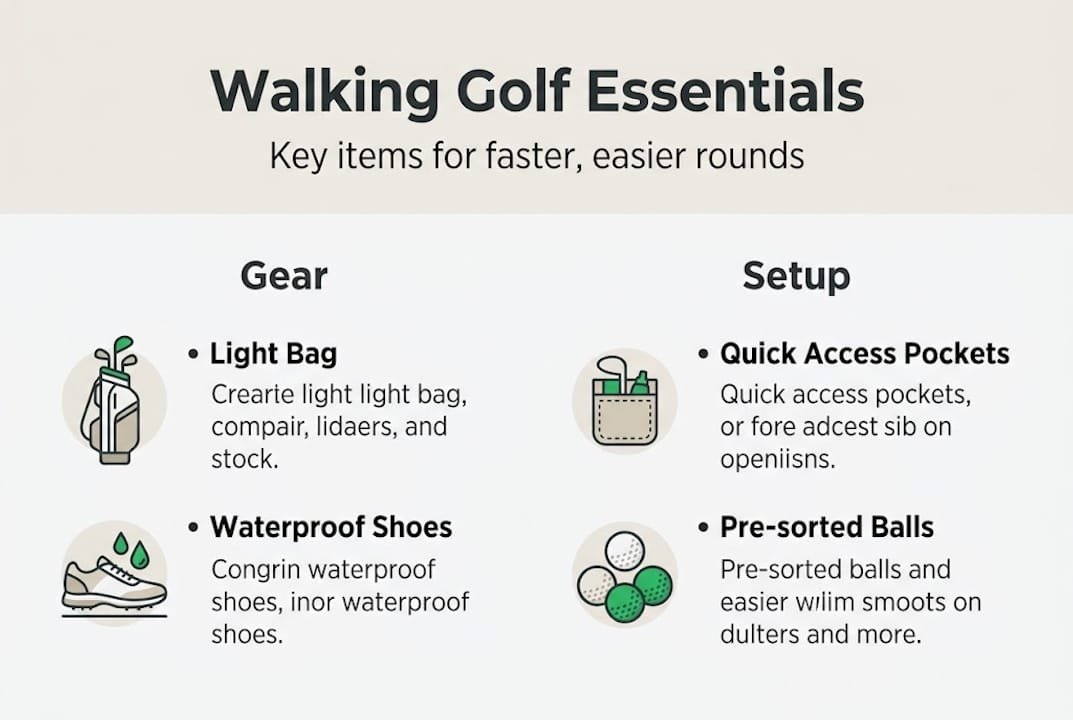
Start with the right bag. A lightweight stand bag in the 3.5 to 5 lb range is the standard for walking rounds. It should have a minimum of six pockets with clearly defined purposes. Review the full breakdown of golf bag essentials to confirm your current bag meets the demands of a walking round before you commit to a setup.
Core gear checklist for walking golfers:
- Lightweight stand bag (3.5 to 5 lbs)
- Waterproof or water-resistant rain jacket stored in a dedicated pocket
- At least two sleeves of balls pre-loaded in an outer pocket
- Tees, divot tool, and ball marker in a quick-access pouch
- Hydration: insulated water bottle or a bag with a built-in holder
- Sunscreen, gloves, and a towel clipped or magnetically attached to the bag
- Rangefinder or GPS device in a velcro or zipper side pocket
| Gear category | Recommended spec | Why it matters for walking |
|---|---|---|
| Bag weight | Under 5 lbs | Reduces cumulative fatigue over 5 miles |
| Pocket count | 6 or more | Enables intentional organization |
| Footwear | Waterproof, spiked or spikeless | Stability on wet or uneven terrain |
| Hydration | 20+ oz insulated bottle | Sustains energy and focus |
| Weather protection | Compact rain jacket | Fast access without unpacking |
Footwear deserves its own callout. Waterproof golf shoes with adequate grip are non-negotiable for walking rounds. Wet feet and unstable footing are two of the fastest ways to lose focus mid-round.
Pro Tip: Prep your bag the night before. Load every pocket intentionally, charge your rangefinder, and confirm your ball and tee supply. Arriving at the course with a fully staged bag eliminates the frantic pre-round scramble and lets you warm up instead.
Electric caddies are increasingly popular for walking golfers who want to preserve energy without sacrificing the walk. They handle the weight so your legs handle the miles.
Step-by-step: Organizing your golf bag for walking
With your essentials in hand, here’s how to organize everything for minimal hassle and fast play on the move.
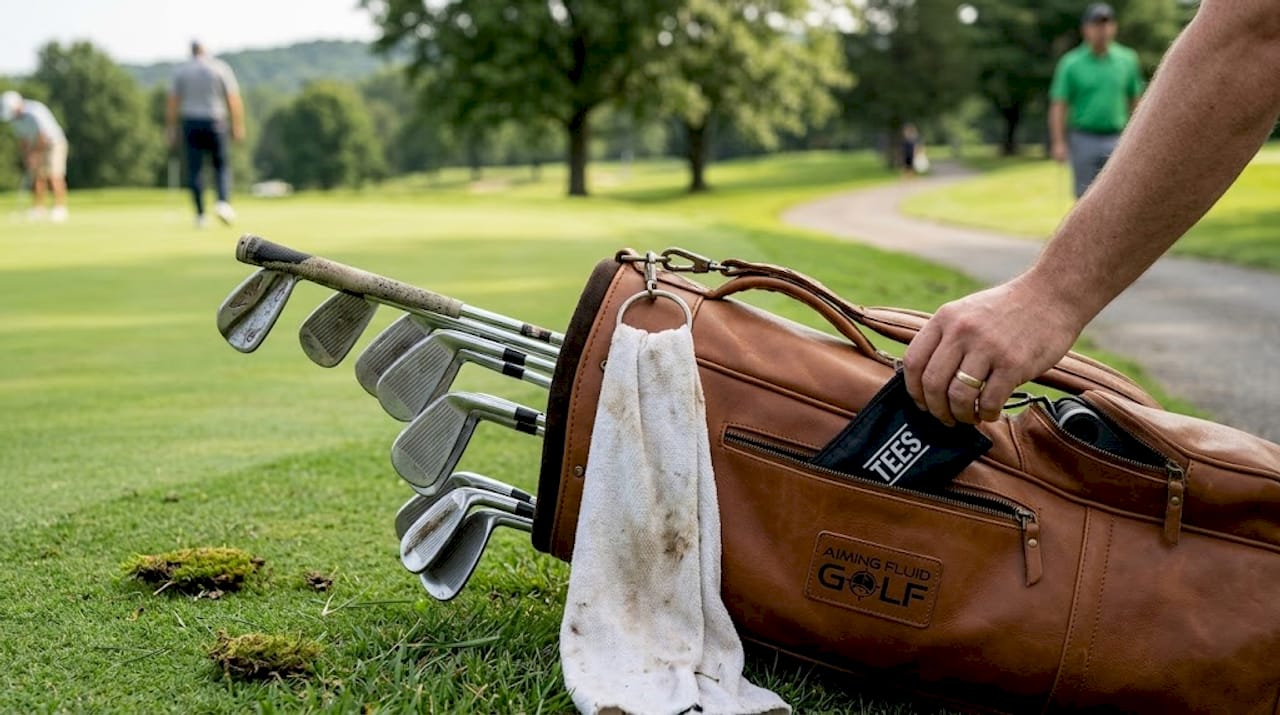
The difference between a well-organized bag and a randomly packed one shows up most clearly when you’re 200 yards from the green, time is tight, and you need your 7-iron and a tee in under five seconds. Intentional placement is a system, not a preference. Learn how to organize your golf bag using a structured method that mirrors how touring professionals approach their setups.
Step-by-step bag organization for walking rounds:
- Top section (club dividers): Place woods and driver at the top of the bag, nearest the strap. Irons in the middle. Wedges and putter at the bottom for easy pull-out near the green.
- Main front pocket: Rain jacket, extra glove, and a small first aid kit. Items used infrequently but needed fast when weather changes.
- Side hip pockets: Balls on one side, tees and markers on the other. These are your highest-frequency access points.
- Valuables pocket: Keys, wallet, and phone. Fleece-lined if available. Never mixed with wet gear.
- Apparel pocket: Extra socks or a light layer. Separate from valuables to avoid moisture transfer.
- Accessory loop or clip: Magnetic towel, glove holder, or rangefinder pouch attached externally for zero-dig access.
Pros use custom tags and pouches to identify high-frequency items at a glance, reducing time spent searching during competitive rounds. You can replicate this with color-coded zipper pulls or labeled pouches.
| Setup style | Average time to locate gear | Pace impact |
|---|---|---|
| Random fill | 15 to 30 seconds per item | Adds 10 to 20 minutes per round |
| Intentional system | 3 to 5 seconds per item | Maintains pace, reduces frustration |
The contrast is stark. A random fill approach treats every pocket as general storage. An intentional system assigns every item a fixed home based on frequency of use. The golf convenience workflow framework applies this logic across your entire on-course routine, not just your bag.
Pro Tip: Use colored zipper pulls or small labeled tags on your most-used pockets. When you’re moving fast between holes, your hands find the right pocket by feel and color before your brain even processes the decision.
Choosing carts, caddies, and carry options
To maximize your walking experience, your mode of transporting your bag can make all the difference.
How you move your bag across the course directly affects your energy level, your pace, and how well your organizational system actually functions under real conditions. Carrying your bag on your shoulder is the purest form of walking golf, but it comes with tradeoffs that compound over 18 holes.
| Transport option | Fatigue level | Pace impact | Organizational space | Cost range |
|---|---|---|---|---|
| Carry (double strap) | High | Moderate | Limited | $0 (bag only) |
| Manual push cart | Low to moderate | Good | Moderate (add-on holders) | $80 to $300 |
| Electric caddy | Very low | Excellent | High (built-in accessories) | $500 to $2,500 |
Carrying works well for fit golfers playing fewer than 18 holes or on flat courses. But on hilly terrain or in heat, shoulder fatigue accumulates and affects swing mechanics by the back nine.
Manual push carts solve the fatigue problem for most golfers. They keep your bag stable, free your hands, and often include accessory holders for drinks, scorecards, and rangefinders. The best manual push carts of 2025 offer three-wheel stability and fold-flat storage that fits in most car trunks.
Electric caddies are recommended for maintaining pace and reducing physical strain, particularly on courses with significant elevation changes. Remote-follow models track your movement automatically, keeping your bag within reach without requiring you to push or steer.
Key benefits of walking with a cart or caddy:
- No cart fees, saving $15 to $30 per round at most courses
- Consistent bag stability means accessories stay in their designated spots
- Hands-free movement allows you to read the course and plan shots while walking
- Reduced fatigue preserves swing quality through the final holes
Review the full comparison of electric golf caddies to match the right model to your course conditions and budget.
Speed hacks: Accessories and habits for faster, smoother play
Now, let’s turn efficient setup into time saved on the course with these key speed hacks.
Even a perfectly organized bag loses its advantage if your on-course habits create friction. Speed on the course comes from eliminating micro-delays: the five seconds you spend unclipping a towel, the ten seconds searching for a tee, the thirty seconds locating your scorecard. Multiply those across 18 holes and you’ve added real time to your round.
“Walking golfers with organized accessories move efficiently and finish rounds quicker.”
Top accessories for faster walking rounds:
- Magnetic towel: Attaches and detaches from your bag in one motion. No unclipping, no searching. The Aiming Fluid magnetic system uses a rated pull-force magnet that holds through bag movement but releases instantly when you reach for it.
- Utility pouch: A dedicated pouch for tees, markers, and a divot tool keeps your three most-used items in one place. No digging through pockets.
- Quick-draw ball holder: Clips to your bag or belt and holds two to three balls for immediate access between holes.
- Scorecard holder: A rigid or semi-rigid holder attached to your push cart or bag keeps your card flat, dry, and readable without unfolding.
- Rangefinder clip: External clip placement means your device is out and in your hand in under two seconds.
Workflow habits matter as much as gear. Pre-load your side pockets with exactly the number of balls you’ll use for the next three holes. Carry only the tees you need for the current hole type. Keep your rain jacket in the same pocket every single round so muscle memory does the work in bad weather.
Review the simple golf tips framework for additional on-course habits that pair well with an organized walking setup. The bag essentials for speed guide also covers which items to cut from your bag entirely.
Pro Tip: Walk to your ball while your playing partner is hitting. Use that time to select your club and confirm yardage. By the time it’s your turn, you’re ready to play. This single habit, combined with a well-organized bag, can shave 20 minutes off your round without rushing a single shot.
What most golfers get wrong about walking organization
Most golfers approach bag organization as a one-time setup task rather than a repeatable system. They pack carefully before the first round of the season, then gradually let it drift into disorder as the weeks go on. By midsummer, the bag is back to random fill.
The real insight from experienced walkers is this: less gear, consistently placed, beats more gear loosely managed. Every time. Golfers who carry every gadget available but can’t locate their divot tool in under five seconds are slower than golfers with half the gear and a fixed system.
The convenience workflow perspective makes this point clearly: pros and frequent walkers don’t just have better gear, they have better routines. They reset their bag after every round. They know exactly what’s in every pocket without looking. That level of consistency is built through repetition, not through buying more accessories.
Focus on repeat-use items in fixed, accessible locations. Everything else is noise.
Gear up: Top picks for organized, high-performance walking
Ready to walk your fastest, most organized round ever? Here’s how to set yourself up for success.
Being properly organized on the course isn’t about having the most gear. It’s about having the right gear, placed correctly, ready to use without thought. That’s exactly what Aiming Fluid Golf designs for.

Browse the full range of best golf accessories curated for walking golfers who prioritize pace and performance. The magnetic golf towels system is one of the most practical upgrades any walking golfer can make, eliminating one of the most common sources of on-course delay. Pair it with the 5-in-1 divot tool to consolidate your most-used accessories into a single, always-ready tool. Every product is engineered to solve a specific on-course problem, not to fill space in your bag.
Frequently asked questions
What is the most important accessory for walking golfers?
A lightweight, well-organized stand bag paired with an electric or push cart is the most impactful combination for most walking golfers, reducing fatigue and improving pace across all 18 holes.
How can I avoid losing time searching for gear on the course?
Organize high-use items like tees and balls in dedicated outer pockets, and use custom tags or pouches for quick visual identification so you never dig through the wrong pocket mid-round.
Are electric caddies really worth it for walking golfers?
Yes. Electric caddies reduce fatigue and maintain consistent pace across a full round that can cover up to 5 miles, making them a strong investment for golfers who walk regularly.
What’s the quickest way to speed up play when walking?
Stick to essential gear only, pre-pack pockets before each round, and use smart accessories like magnetic towels that eliminate the most common micro-delays between shots.
Recommended
- Personal gear in golf: cut retrieval time by 50% – Aiming Fluid Golf
- Golf round preparation guide: boost your game in 2026 – Aiming Fluid Golf
- Master on-course gear management for peak golf performance – Aiming Fluid Golf
- Ultimate Beginner’s Golf Gear Guide: Essential Clubs, Tools & Etiquett – Aiming Fluid Golf


