


TL;DR:
- Effective golf preparedness involves consistent mental routines, physical warm-ups, and strategic course planning to enhance performance and confidence. Regularly practicing routines like STOP S.L.O.W. GO and studying course conditions enable better focus and adaptability under pressure. Organized gear and timely arrival support a smooth, distraction-free experience, aligning amateurs with elite professionals’ disciplined approaches.
Preparedness in golf is defined as the deliberate alignment of mental focus, physical conditioning, and tactical awareness before and during every round. The importance of staying prepared in golf goes beyond packing your bag the night before. Research confirms that golfers who follow structured pre-shot routines, disciplined warm-ups, and course-specific strategies make fewer errors, recover faster from bad shots, and finish rounds with more energy and confidence. This guide breaks down each layer of preparation, from cognitive frameworks used by NCAA coaches to the 44-minute warm-up Nelly Korda uses before competition, so you can build a system that works for your game.
What mental strategies make preparedness essential on the golf course?
Mental readiness is the most underestimated dimension of golf game preparation. Most amateur golfers spend 90% of their preparation time on swing mechanics and almost none on attention regulation. That imbalance explains why technically sound players fall apart under pressure.
The STOP S.L.O.W. GO pre-shot routine is a six-step attentional framework validated by NCAA Division I coaches to reduce mind-wandering and improve shot consistency. Each step guides the golfer from environmental assessment through target lock to execution, creating a repeatable cognitive sequence that replaces anxiety with process. The practical effect is that your brain has a job to do before every shot, which crowds out the distracting thoughts that cause rushed or tentative swings.
Pre-shot routines work because they regulate attention away from task-irrelevant thinking. This cognitive shift is the mechanism behind why routines hold up under pressure when raw talent often does not. A golfer who has rehearsed a six-step sequence 500 times in practice will execute it on the 18th hole of a club championship. A golfer relying on feel alone will not.
Key mental preparation habits that support golf readiness include:
- Consistent pre-round visualization: Spend five minutes before your round mentally rehearsing three or four specific shots you expect to face, including a challenging approach and a pressure putt.
- Attentional anchoring: Use a physical trigger, such as gripping the club or taking a breath, to signal the start of your pre-shot routine and block external distractions.
- Process goals over outcome goals: Focus on executing your routine correctly rather than on score. This reduces pressure-induced errors on critical holes.
- Post-shot reset: After a poor shot, use a deliberate reset cue, such as a specific phrase or a look at the sky, to prevent one bad hole from compounding into three.
“Preparation is the foundation of confidence. When you have a routine, you stop reacting to the course and start executing your plan.” This principle drives Scottie Scheffler’s consistent preparation mindset, which remains unchanged whether he is playing a Tuesday practice round or the final round of a major.
Pro Tip: Build your pre-shot routine in practice first. Repeat it on every shot during range sessions, not just on the course. Consistency in low-stakes environments is what makes it automatic under pressure.
Staying focused in golf is not a talent. It is a trained behavior that responds directly to the quality of your preparation system.
How does physical preparation prevent injury and boost performance in golf?
Physical readiness is the structural foundation that supports every other element of golf preparation. A golfer who arrives at the first tee cold, stiff, and rushed is operating at a mechanical disadvantage before the round even begins. Conditioning and warming up reduce injury risk and fatigue, enabling longer and more comfortable play by improving coordination and mobility before sudden movement demands hit the body.
The golf swing requires rotational power, hip mobility, and shoulder flexibility across 18 holes. Without preparation, the body compensates with poor mechanics, which increases the risk of lower back strain, golfer’s elbow, and hip flexor injuries. These are not random occurrences. They are predictable outcomes of skipping physical readiness.
A structured 15-minute warm-up with phases for physical activation, short game, putting, and range practice gives the body and mind time to synchronize before the first tee shot. This is not about hitting 50 balls. It is about sequencing movement so your body is ready to perform.
Follow this warm-up sequence before your next round:
- Minutes 1 to 3: Dynamic mobility. Perform hip circles, torso rotations, and leg swings. These movements activate the joints and muscles used in the swing without overloading cold tissue.
- Minutes 4 to 6: Chipping and pitching. Start with short, controlled swings to establish tempo and feel. Use wedges only. The goal is rhythm, not distance.
- Minutes 7 to 9: Putting green. Roll 10 to 15 putts from varying distances. Focus on pace control rather than holing putts. This calibrates your feel for green speed before the round.
- Minutes 10 to 13: Range work. Begin with a 7-iron or 8-iron and work up to your driver. Hit no more than 15 to 20 balls. Swing at 70% effort to build tempo, not to impress.
- Minutes 14 to 15: Final mental reset. Stand quietly, review your game plan for the first three holes, and walk to the tee with intention.
Pro Tip: Account for transit time when planning your arrival. Arriving 30 minutes early gives you buffer for parking, bag drop, and shoe changes before your warm-up clock starts. Golfers who underestimate logistics consistently rush their routines and pay for it on the front nine.
For a detailed protocol built around injury prevention and early season distance, the Aimingfluidgolf pre-round warm-up guide covers the full sequence with timing breakdowns.
What logistical and course-specific preparations improve golf readiness?
Golf strategy planning extends well beyond the practice range. The role of preparedness on the golf course includes knowing the layout, reading environmental variables, and organizing your equipment so nothing interrupts your focus mid-round.
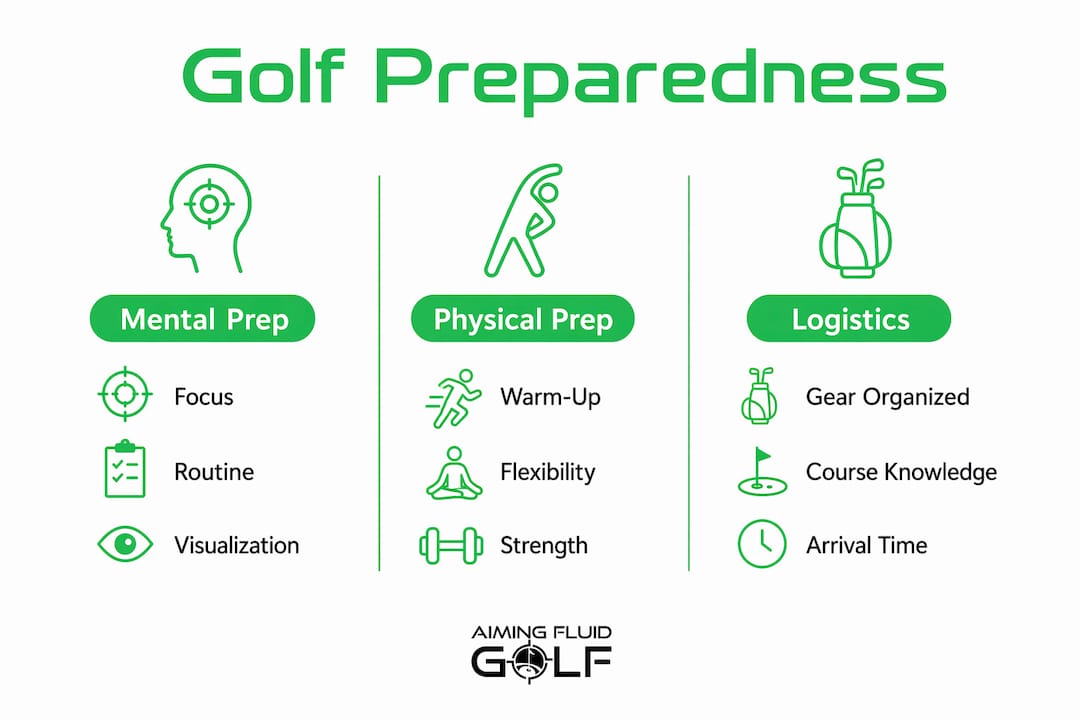
Studying course conditions before play, including green speed, slope, and wind patterns, gives you a tactical framework that replaces guesswork with informed decisions. A golfer who knows that the 14th green runs fast and breaks hard left will approach that hole with a specific plan. A golfer who discovers that on the green will three-putt.
Weather is not a minor variable. Weather shifts at the PGA Championship have altered scoring drastically, confirming that preparedness must include adaptability to changing conditions throughout a round. Knowing how to adjust club selection, shot shape, and pace of play when wind picks up or rain arrives separates prepared golfers from reactive ones. Aimingfluidgolf’s wet weather preparation guide covers the gear and tactical adjustments that keep your game intact when conditions shift.
Organizational readiness also matters more than most golfers acknowledge. When your bag feels like a junk drawer, you waste time and mental energy locating tees, towels, and ball markers at critical moments. That friction compounds over 18 holes.
| Preparation area | What to do | Why it matters |
|---|---|---|
| Equipment check | Verify clubs, balls, tees, and gloves the night before | Eliminates pre-round stress and rushed substitutions |
| Course familiarization | Review the scorecard and hole layouts before arrival | Builds a tactical plan for approach shots and risk management |
| Weather adaptation | Check forecasts and pack rain gear or extra layers | Prevents performance disruption from unexpected conditions |
| Gear organization | Use labeled pouches and accessible towel systems | Reduces time spent searching and keeps focus on the shot |
Key logistical habits that support consistent readiness:
- Confirm your tee time and travel route the evening before to eliminate morning variables.
- Pack your bag in a fixed order every round so muscle memory guides retrieval, not conscious search.
- Review the pin sheet or course app for green positions and yardages before your warm-up, not on the first tee.
How do elite golfers exemplify the role of preparedness in their routines?
Elite players treat preparation as non-negotiable. Their routines are not superstitions. They are systems built from years of identifying what produces consistent performance and then protecting those conditions before every round.
Nelly Korda’s 44-minute pre-round warm-up is one of the most detailed examples in professional golf. Her sequence moves through putting, chipping, bunker work, and full range sessions in a specific order designed to build feel progressively rather than peak too early. The lesson for amateurs is not to copy her exact timing but to recognize that sequencing matters. Starting with full driver swings before your body is warm is the opposite of what produces readiness.
Scottie Scheffler’s preparation philosophy centers on consistency regardless of stakes. His pre-round routine does not change between a practice round and a major championship final. This consistency is deliberate. When the routine is identical, the brain does not register the difference in pressure, which reduces performance anxiety at the moment it matters most.
“The best players don’t prepare harder for big events. They prepare the same way every time. That consistency is the preparation.” This principle applies directly to amateur golfers competing in club championships or member-guest events.
Amateurs can extract three specific lessons from professional routines:
- Sequence your warm-up from short to long. Start with putting and chipping before moving to full swings. This mirrors how pros build feel progressively.
- Treat every pre-round session as identical. Resist the urge to hit more balls before a big round. Volume does not equal readiness. Consistency does.
- Incorporate course-specific practice. Practice that mirrors course variability enhances skill transfer during actual rounds. If the course has a tight driving hole, practice a controlled fade before you play it.
For a deeper look at how amateur golfers can structure their season around preparation principles, the World Amateur Golf Tour’s planning guide offers practical frameworks for competitive readiness across a full season.
Key takeaways
Staying prepared in golf requires integrating mental routines, physical warm-ups, logistical organization, and course-specific strategy into a consistent system applied before every round.
| Point | Details |
|---|---|
| Mental routines reduce errors | The STOP S.L.O.W. GO framework regulates attention and cuts pressure-induced mistakes. |
| Physical warm-up prevents injury | A 15-minute sequenced warm-up improves mobility and reduces common golf injuries. |
| Logistics shape readiness | Arriving 30 minutes early and organizing gear eliminates self-inflicted distractions. |
| Elite routines teach consistency | Nelly Korda and Scottie Scheffler both use fixed, repeatable systems regardless of event size. |
| Course knowledge builds confidence | Studying green speed, slope, and weather before play replaces guesswork with tactical decisions. |
Why most golfers are preparing for the wrong things
Most golfers I observe spend their preparation time trying to fix their swing. They arrive at the range, hit 60 balls with a driver, and walk to the first tee wondering why their tempo feels off. The swing was never the problem. The preparation system was.
What actually separates consistent golfers from inconsistent ones is organizational and mental readiness. When your gear is accessible, your routine is rehearsed, and your course plan is set before you tee off, the swing takes care of itself. You are not thinking about where your towel is or whether you have enough tees. You are focused on the shot in front of you.
The golfers I have seen improve fastest are the ones who treat preparation as a skill to develop, not a checklist to complete. They build mental preparation habits the same way they build swing mechanics: deliberately, repeatedly, and with feedback. They also pay attention to the details that most players dismiss, like knowing the green speed before they putt or having their rain gear ready before the clouds arrive.
Preparation also makes golf more enjoyable. When you are not scrambling for equipment or reacting to surprises, you can actually be present on the course. That mindfulness is where the real satisfaction in the game lives, regardless of your score.
— Gary
Gear that keeps you organized and ready every round

The right accessories do not improve your swing. They remove the friction that interrupts your focus. Aimingfluidgolf designs gear specifically for golfers who want every piece of equipment accessible, clean, and ready without digging through their bag mid-round. The magnetic towel system attaches and detaches instantly, so you never lose 15 seconds searching at a critical moment. Precision tees, utility pouches, and divot tools are built to the same standard: practical, durable, and organized by design. Browse the full expert-vetted accessory collection to find gear that matches how seriously you take your preparation.
FAQ
What is the most effective mental preparation routine for golf?
The STOP S.L.O.W. GO pre-shot routine is a validated six-step framework used by NCAA Division I coaches to reduce mind-wandering and improve shot consistency under pressure. Applying it before every shot creates a repeatable attentional sequence that replaces anxiety with process focus.
How early should you arrive before a round of golf?
Arriving at least 30 minutes before your tee time gives you enough buffer for logistics and a full 15-minute structured warm-up. Golfers who underestimate transit and setup time consistently rush their routines and compromise physical and mental readiness.
How do pros like Nelly Korda prepare before a round?
Nelly Korda uses a 44-minute sequenced warm-up that progresses from putting through chipping, bunker work, and full range sessions. The key principle is building feel progressively rather than peaking early with high-effort swings.
Why does course-specific preparation matter for amateurs?
Studying green speed, slope, and wind patterns before play gives you a tactical plan for each hole rather than making decisions under pressure on the course. Practice that mirrors actual course conditions also improves skill transfer during rounds.
How does gear organization affect golf performance?
Disorganized equipment forces you to search for items at critical moments, breaking your focus and adding friction to your routine. A structured bag setup with accessible pouches and a magnetic towel system keeps your attention on the shot, not on your gear.
Recommended
- Golf round preparation guide: boost your game in 2026 – Aiming Fluid Golf
- Spring Golf Bag Essentials: 5 Items to Replace Before Your First Round – Aiming Fluid Golf
- Golf preparation: unlock consistency and confidence – Aiming Fluid Golf
- Master golf gear preparedness for peak performance – Aiming Fluid Golf


