


TL;DR:
- Regular cleaning maintains optimal spin and extends golf club lifespan by three to five years.
- On-course habits like quick wipes after each shot prevent performance degradation.
- Proper organization and quality accessories ensure consistent, effective club maintenance routines.
Dirty grooves cost you more than you think. Spin rates drop from 10,500 rpm to as low as 5,759 rpm on wedges when grooves are clogged with dirt and debris. That’s not a minor performance dip — that’s the difference between a ball that checks up and one that skips past the pin. Regular maintenance preserves spin, extends club life by three to five years, and keeps your equipment performing the way it was engineered to. This guide covers the tools you need, the routines that work, the mistakes to avoid, and the accessories that make club care faster and more consistent.
Table of Contents
- What you need to keep clubs ready
- Routine cleaning and maintenance: Step-by-step
- Common mistakes and troubleshooting
- Premium accessories and organization tips
- Why most golfers get club readiness wrong: A pro’s perspective
- Level up your club care with premium accessories
- Frequently asked questions
Key Takeaways
| Point | Details |
|---|---|
| Clean clubs extend life | Proper maintenance can add 3-5 years to your clubs’ usable lifespan. |
| Dirty grooves cost spin | Neglected grooves can halve your wedge spin, hurting control. |
| Keep gear ready with accessories | Using premium towels, brushes, and organizers saves time and boosts consistency. |
| Small habits make a big difference | Frequent, quick cleaning after each shot is more important than rare deep cleans. |
What you need to keep clubs ready
Now that you understand what happens when you neglect your clubs, let’s look at what you need to keep them performing their best. Club care doesn’t require a full workshop. A focused set of tools, used consistently, handles the job.
Core tools every golfer needs:
- Groove cleaner or pick: Removes compacted dirt from groove channels where brushes can’t reach.
- Dual-head brush: One side for scrubbing face grooves, one softer side for shafts and grips. A best dual-head brush with an oversized head covers more surface area per stroke.
- Microfiber towel: Absorbs moisture and lifts fine particles without scratching club faces.
- Warm water and mild dish soap: For post-round soaking and scrubbing at home.
- Soft-bristle toothbrush: Ideal for cleaning around hosels and ferrules.
Specialty products for premium care:
- Club face cleaning spray for quick degreasing between rounds.
- Shaft polish to protect against oxidation on steel shafts.
- Grip cleaner to restore tackiness and extend grip life.
For a full breakdown of what each product does and when to use it, the complete cleaning guide covers every scenario from light field cleaning to full restoration.
| Tool | Primary use | Frequency |
|---|---|---|
| Groove cleaner | Clear debris from grooves | Every shot/round |
| Dual-head brush | Scrub face and shaft | Every round |
| Microfiber towel | Wipe and dry club face | Every shot |
| Mild soap + water | Deep clean at home | Weekly or monthly |
| Grip cleaner | Restore grip tackiness | Monthly |
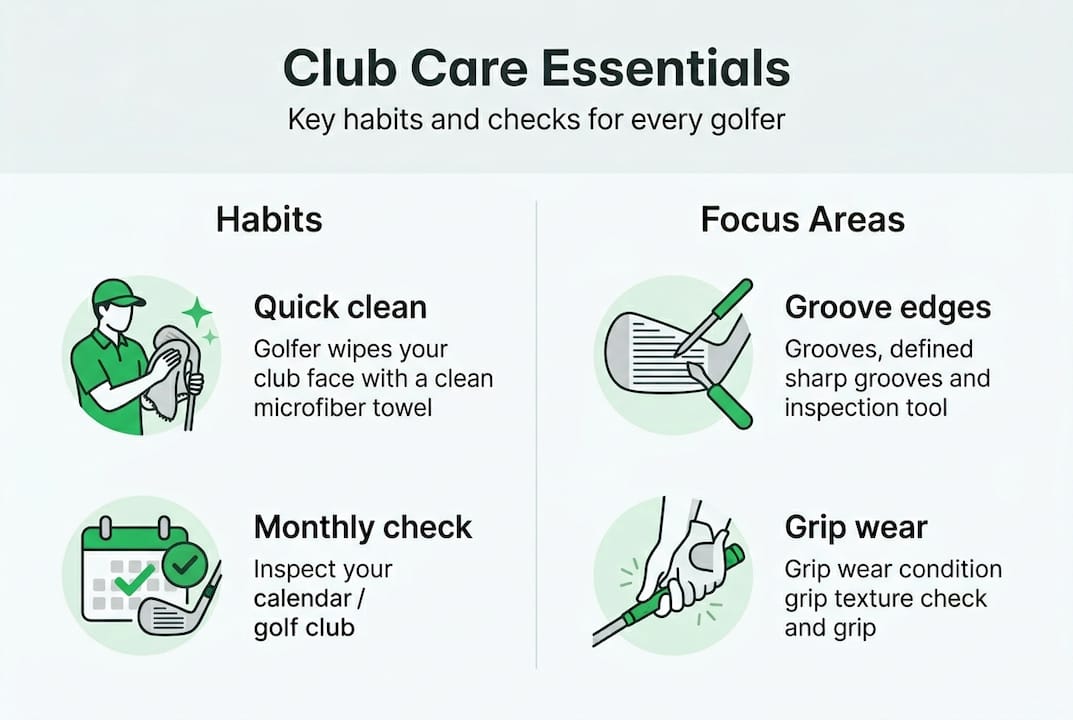
Quick on-course cleaning after every shot with a towel and brush is the single most effective habit you can build. It takes three seconds and prevents the compaction that makes deep cleaning necessary more often.
Pro Tip: Clip your brush and towel to your bag in a fixed spot. When they’re always in the same place, you’ll actually use them instead of skipping the wipe because you can’t find them.
Routine cleaning and maintenance: Step-by-step
With your tools ready, it’s time to break down the most effective cleaning routines for peak club performance.
After every round (10 minutes):
- Fill a bucket or sink with warm water and a few drops of mild dish soap.
- Submerge iron and wedge heads for five minutes. Do not submerge woods or putters.
- Scrub groove channels with your dual-head brush using firm, straight strokes.
- Use a groove pick for any remaining packed debris.
- Rinse with clean water and dry immediately with a microfiber towel.
- Wipe down shafts and grips with a damp cloth.
Monthly deep clean:
Regular golfers should clean clubs after every round with warm soapy water and a soft brush, and perform a full deep clean monthly. The monthly session adds a shaft inspection, grip condition check, and a close look at ferrules and hosels for early signs of wear.

| Method | Setting | Time required | Key benefit |
|---|---|---|---|
| Quick wipe | On-course | 5-10 seconds | Maintains spin every shot |
| Post-round wash | Home/locker room | 10 minutes | Removes round buildup |
| Monthly deep clean | Home | 30-45 minutes | Extends club life, catches wear |
For a full walkthrough of how tour-level players structure their cleaning sessions, the professional cleaning routine breaks it down step by step.
“Clean grooves are the foundation of short game control. Without them, technique alone can’t compensate for the lost friction between club face and ball.”
Pro Tip: Monthly inspections aren’t just about cleaning. Check for micro-cracks near the hosel, worn groove edges, and grip slippage. Catching these early prevents bigger problems and keeps your equipment reliable round after round.
For golfers focused on maintaining spin through the bag, preventing spin loss starts with understanding how groove geometry degrades over time and what cleaning practices slow that process.
Common mistakes and troubleshooting
Even with the right routine, mistakes happen. Here’s how to avoid common errors and get your clubs back on track if issues arise.
Mistakes that damage clubs or reduce performance:
- Using steel wool or abrasive pads: These scratch club faces and can remove protective coatings on irons and wedges.
- Soaking woods or putters: Water infiltrates the hosel joint and weakens the adhesive bond between shaft and head.
- Using harsh chemicals: Bleach and strong degreasers strip finish from club heads and degrade grip rubber over time.
- Skipping groove cleaning: Wiping the face without clearing the grooves leaves the most performance-critical area dirty.
- Letting clubs dry with moisture in grooves: Trapped water accelerates rust formation, especially on raw or uncoated wedges.
Rust: when it’s a problem and when it isn’t.
Some players prefer light rust on wedges because it increases friction between the club face and ball, generating more spin in certain conditions. Raw finish wedges are specifically designed to develop this surface texture over time. Surface rust on a raw wedge is not a failure — it’s a feature for many tour players.
However, rust inside groove channels or on the hosel is a different issue. That type of corrosion reduces groove sharpness and can compromise structural integrity. Address it with a groove brush and light rust remover, then dry thoroughly.
“The goal isn’t a museum-quality club. It’s a club that performs. Sometimes those look different.”
For a full breakdown of what to do and what to avoid, the club care do’s and don’ts covers the most common errors with clear corrective steps.
Pro Tip: Grips are the most neglected part of club maintenance. A worn grip forces you to grip tighter, which increases tension through the forearms and wrists. The grip maintenance guide outlines a simple monthly cleaning routine that restores tackiness and extends grip life significantly.
Premium accessories and organization tips
Maximizing readiness isn’t just about cleaning. Using the right accessories and smart organization sets you up for consistent success.
The best club care systems work because they remove friction from the process. When your towel is clipped in a fixed spot, your brush is always accessible, and your cleaning supplies are organized in a dedicated pouch, you stop skipping steps. Regular maintenance can extend club life by three to five years, and the right accessories make that maintenance automatic rather than effortful.
Accessories worth investing in:
- Magnetic towel: Attaches and detaches instantly from your bag or cart, eliminating the search-and-fumble that leads to skipped wipes.
- Oversized dual-head brush: Covers more face area per stroke and handles both groove cleaning and shaft wiping in one tool.
- Premium utility pouch: Keeps groove picks, tees, ball markers, and cleaning supplies organized in one accessible location.
- Divot tool with brush attachment: Combines two tasks into one carry item, reducing what you need to track.
- Headcovers with clear labeling: Protect club faces from contact scratches during transport and storage.
| Accessory | Key feature | Performance benefit |
|---|---|---|
| Magnetic towel | Instant attach/detach | Faster wipe routine, no searching |
| Dual-head brush | Two bristle types | Handles grooves and shafts in one pass |
| Utility pouch | Organized compartments | All cleaning tools in one place |
| Divot tool + brush | Dual function | Reduces carry items, speeds up play |
| Premium headcovers | Face protection | Prevents contact damage between rounds |
For golfers who want to see how these tools fit into a broader performance setup, premium accessories covers the full range of gear worth carrying. The habits that separate well-prepared golfers from the rest are detailed in scratch golfer habits, and organization is consistently near the top of that list.
Why most golfers get club readiness wrong: A pro’s perspective
Most golfers treat club care as a once-in-a-while task rather than a continuous habit. That’s the core mistake. The players who consistently show up with game-ready equipment aren’t spending more time on maintenance — they’re spending less, because they’ve built micro-habits that prevent buildup from ever becoming a problem.
The real insight from inside-the-ropes tour habits is this: quick, frequent cleaning beats infrequent deep cleaning every time. A three-second wipe after each shot does more for groove performance than a thirty-minute soak once a month. Frequency is the mechanism. Depth is secondary.
Organization plays a larger role than most golfers recognize. When your tools are disorganized, you skip steps under time pressure. That’s not a discipline problem — it’s a systems problem. Fix the system, and the behavior follows. Golfers who avoid beginner mistakes in club care aren’t more disciplined. They’ve simply built better defaults into their bag setup.
The overlooked factor is mental clarity. Walking to your ball knowing your clubs are clean and ready removes a small but real source of distraction. That clarity compounds over eighteen holes.
Level up your club care with premium accessories
The routines and tools covered in this guide are only as effective as the equipment you use to execute them. Worn brushes, missing towels, and disorganized pouches create gaps in your maintenance system that cost you performance over time.

Aiming Fluid Golf designs accessories specifically to close those gaps. From magnetic towels that stay accessible on every hole to a utility pouch built to organize every cleaning tool you carry, each product is engineered around real on-course use. Browse the full best golf accessories selection to find the tools that fit your game and your bag setup.
Frequently asked questions
How often should you clean your golf clubs?
Clean your clubs after every round for optimal performance and perform a full deep clean monthly to extend their lifespan and catch early signs of wear.
Is it bad to leave some rust on your wedges?
Light rust on wedges can actually increase spin, and many players specifically prefer raw finish wedges for this reason. Rust inside groove channels, however, should be removed.
What tools are essential for keeping clubs ready on the course?
A soft-bristle brush, microfiber towel, and groove cleaner are the three essentials. Quick on-course cleaning after every shot with these tools prevents the buildup that degrades spin and control.
How does dirt in grooves affect your golf shots?
Dirty grooves cut spin from 10,500 rpm down to 5,759 rpm on wedges, which severely reduces your ability to control ball flight, check distance, and hold greens.
Recommended
- How to Organize Your Golf Bag Like a Pro: The Peter Finch Method – Aiming Fluid Golf
- How to Clean Golf Clubs Properly — The Complete Guide for Better Conta – Aiming Fluid Golf
- How to Clean Golf Clubs & Balls Like a Pro (Without Losing Spin) – Aiming Fluid Golf
- Ultimate Club & Grip Maintenance Guide: Extend the Life of Your Irons – Aiming Fluid Golf
- How to choose grip accessories for premium wooden gear - Gripnatic


