


TL;DR:
- Golf confidence is a mental state impacting decision-making, muscle control, and resilience.
- Mental fatigue from prolonged play diminishes focus, especially affecting putting accuracy late in rounds.
- Structured routines, proper organization, and elite mental strategies help build and maintain confidence on course.
You step onto the 14th tee with a solid round going, then your mind starts running the math on your scorecard. Suddenly your grip feels wrong, your swing tempo disappears, and the ball lands nowhere near your target. Your skill level hasn’t changed in the last two hours. Your confidence has. This guide breaks down exactly what golf confidence is, how mental fatigue chips away at it as the round progresses, what elite players do to protect it, and how the right habits and gear give you a practical, repeatable edge every time you play.
Table of Contents
- What is golf confidence and why does it matter?
- The science: How mental fatigue affects your golf game
- What the pros get right: Mindset, goals, and controlling nerves
- Building real confidence: Tools, habits, and game-day routines
- Why your gear choices and organization matter more than you think
- Ready to level up your golf confidence?
- Frequently asked questions
Key Takeaways
| Point | Details |
|---|---|
| Confidence impacts performance | Belief in your ability affects every shot and overall scores. |
| Mental fatigue undermines confidence | Fatigue disrupts focus, putting, and decision-making as rounds progress. |
| Pro routines are repeatable | Goal setting and relaxation strategies used by pros can benefit amateurs. |
| Organization matters | Thoughtful gear and preparation reduce stress and build true on-course confidence. |
What is golf confidence and why does it matter?
Golf confidence is a mental state, not a personality trait. At its core, it is your belief in your own ability to execute a shot or a round, regardless of what happened on the previous hole. That distinction matters because many amateur golfers treat confidence as something you either have or you don’t, like natural talent. The research says otherwise.
Confidence directly influences three measurable mechanisms in your game. First, it shapes your decision-making under pressure, meaning the club you select, the line you pick, and the risk level you accept. Second, it affects muscle control and coordination, because hesitation and doubt introduce tension that disrupts the fluid mechanics your swing depends on. Third, it determines resilience after mistakes. A golfer with high confidence treats a bad shot as data. A golfer with low confidence treats it as confirmation of a deeper problem.
“Confidence is not the absence of doubt. It is the decision to act fully on your best read of the situation, even when the outcome is uncertain.”
Amateurs stand to gain more from confidence work than professionals do, precisely because the gap between their mental game and their physical skill is usually much wider. Many amateur golfers already have the technique to play better than their current handicap suggests. Fixing that gap starts with eliminating avoidable common beginner mistakes and addressing the mental side with the same seriousness as the physical.
Key factors that shape golf confidence include:
- Preparation quality: How well you know your yardages, tendencies, and course conditions before the round starts
- Routine consistency: Whether your pre-shot process is predictable and calm or variable and reactive
- Equipment readiness: Having every tool you need where you expect it, without searching or improvising
- Fatigue management: Protecting your mental sharpness over 18 holes, not just the first nine
- Post-shot response: How quickly you reset after an error and redirect your attention forward
Research confirms that mental fatigue from prolonged play affects putting most severely, followed by iron accuracy, drive distance, and overall 18-hole scores. Confidence is not born. It is built, and the construction materials are evidence-based strategies applied consistently.
The science: How mental fatigue affects your golf game
Mental fatigue is not just feeling tired. It is a measurable cognitive state where sustained decision-making and concentration deplete your brain’s capacity to regulate performance. In golf, this matters a great deal because every shot requires a full reset of your attention, your physical tension levels, and your target focus.
Here’s what the research shows about how fatigue progresses across a full round:
| Performance area | Impact from mental fatigue | When it typically peaks |
|---|---|---|
| Putting accuracy | Most severe decline | Holes 14 to 18 |
| Iron accuracy | Moderate to significant | Back nine, especially holes 12 onward |
| Drive distance | Noticeable but variable | Holes 13 to 18 |
| Overall 18-hole score | Cumulative degradation | Accelerates after hole 10 |
| Decision quality | Consistent decline | Progressive throughout round |
The practical implication here is significant. Most golfers assume late-round score blowups come from mechanical failures or bad luck. In reality, a large share of those collapses trace back to cognitive fatigue reducing the quality of attention they bring to each shot. Your swing did not break down. Your brain’s ability to sustain the precision required for consistent execution ran low on resources.
Statistic callout: Research on golf performance and mental fatigue shows that putting, the most cognitively demanding and pressure-intensive part of the game, shows the most severe degradation under mental fatigue. This is worth remembering every time you arrive at the green late in a round feeling scattered.
Understanding this pattern empowers you to act. Golfers who know this can invest in effective pre-round warmups that prime their cognitive resources, pace their mental energy across the round, and use organizational systems that reduce unnecessary cognitive load during play.
The goal is not to eliminate mental fatigue entirely, that’s not realistic over four-plus hours of play. The goal is to slow its onset and reduce its impact on your most critical shots.
What the pros get right: Mindset, goals, and controlling nerves
Elite golfers are not fearless. That is a myth worth discarding immediately. Tour-level players feel anxiety, nervousness, and doubt just like amateurs do. The meaningful difference is that they have developed structured strategies to channel those states rather than be controlled by them.

A study published in sports science research found that successful professional golfers showed higher cognitive and somatic anxiety, use of relaxation strategies, emotional and attentional control, and performance-approach goals compared to less successful peers. Notably, these variables together predicted 59% of the variance in player ranking. Talent explains some of the gap between players. Psychological strategy explains a significant portion of the rest.
Here’s a comparison of how high-confidence and low-confidence golfers respond to the same situations:
| Situation | High-confidence golfer | Low-confidence golfer |
|---|---|---|
| Bad drive | Resets with pre-shot routine, picks best next shot | Dwells on mistake, tightens grip, forces next shot |
| Pressure putt | Uses breathing technique, focuses on process | Focuses on outcome, rushes or over-thinks |
| Unexpected conditions | Adapts target and strategy, stays calm | Blames conditions, loses composure |
| Late-round fatigue | Relies on routine and gear organization | Improvises, increases error rate |
| Post-round review | Identifies patterns to improve | Focuses on frustration rather than learning |
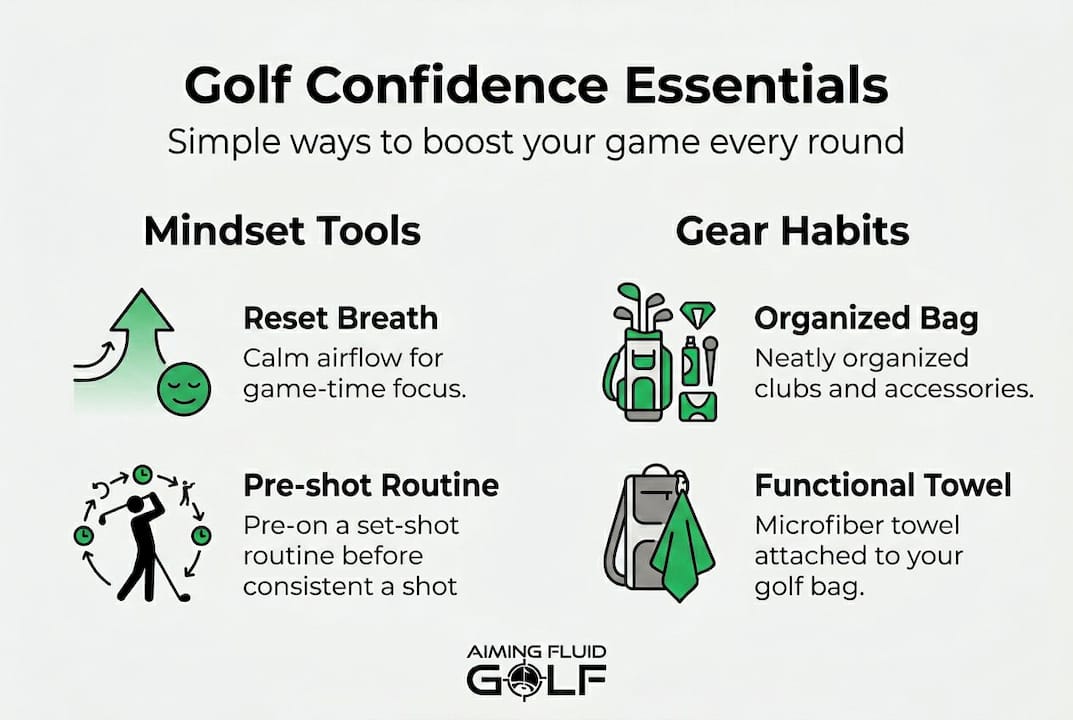
Pro Tip: Borrow one concrete tool from elite play: the two-second reset breath. After any shot, good or bad, take one deliberate breath before you move to your next action. This physiological reset interrupts the spiral of either overconfidence or frustration and re-engages the prefrontal cortex where clear decisions are made.
The goal-setting distinction also matters. Process-based goals (“maintain my tempo on every swing”) outperform outcome-based goals (“shoot under 80”) for confidence maintenance during the round, because you can control process even when results are unpredictable. That said, quick improvement tips and the habits shared by scratch golfer habits consistently point toward one truth: composure is practiced, not wished for.
Here are four mindset practices elite golfers use that any amateur can implement:
- Pre-shot routine standardization: A consistent 5 to 8 second sequence of movements and thoughts before every shot signals to your nervous system that this situation is familiar and manageable
- Target fixation: Lock your visual attention on a precise intermediate target rather than the distant flag; this narrows focus and reduces cognitive overload
- Process goal anchoring: Before each hole, set one process intention, not a score target
- Post-round debrief: After each round, note two execution wins and one decision to improve, keeping your confidence narrative constructive
Building real confidence: Tools, habits, and game-day routines
Knowledge about confidence and fatigue is useful only when it translates into action. This section covers the practical systems, habits, and gear choices that produce real, measurable improvements in how you feel and perform on the course.
Research confirms that psychological tools for controlling anxiety predict a significant portion of performance outcomes at the elite level. The same logic scales down to amateur play. Here’s where to build your system.
Pre-round preparation is where most confidence is either built or lost before you take a single shot. Arriving rushed, disorganized, or under-warmed creates a cognitive deficit you spend the first six holes trying to recover from. A detailed preparation for your next round process should include stretching, warmup swings, a short putting session, and a mental rehearsal of your course strategy.
Your practice routine between rounds is equally important. Consistent golf practice routines build the neural pathways that make your swing feel automatic under pressure. Automaticity is a confidence multiplier because you are not consciously managing mechanics when it matters most.
On the equipment side, organizational accessories play a practical and psychological role that most golfers underestimate. When your bag feels like a junk drawer, the cognitive cost of locating a tee, grabbing your divot tool, or finding your ball marker mid-round is small individually but cumulative across 18 holes. That friction adds up to mental fatigue faster than you’d expect.
Consider these organizational strategies for reducing in-round cognitive load:
- Dedicated accessory placement: Each tool has one home in your bag. Muscle memory takes over, and you never search mid-shot routine
- Pre-round gear check: A 90-second checklist before every round confirms you have tees, a divot tool, a ball marker, and a clean towel ready
- Magnetic systems: Magnetic towel and landing pad setups allow instant attachment and retrieval without breaking stride or attention
- Premium utility pouches: A structured pouch keeps small items separated and retrievable in one motion, not three
You can explore recommended accessories for confidence that are designed specifically around in-round efficiency. The goal is to reduce every unnecessary interruption to your mental state during play.
Pro Tip: Run a “bag audit” before your next round. Pull everything out, remove what you haven’t used in three rounds, and organize what remains into zones: clubs, balls, tees, accessories, and personal items. Your setup time drops, and so does in-round friction. If you’re also considering upgrading your equipment setup, it’s worth exploring golf club options as part of that broader review.
Effective habits that build confidence over time include:
- Journaling two process goals per round and reviewing them post-play
- Practicing under simulated pressure: Play a game within your practice session where you must hole a putt before moving to the next station
- Consistent physical readiness: Sleep, hydration, and a light meal before your round are not optional; they are cognitive performance inputs
- Routine repetition over novelty: The more familiar your gear, warmup sequence, and pre-shot process feel, the less your brain has to work during the round itself
Why your gear choices and organization matter more than you think
Most golf confidence conversations stop at mindset and technique. That’s fair, but incomplete. After years of watching amateur golfers struggle to transfer range performance to the course, one pattern stands out clearly: organization and gear quality are systematically underrated as confidence levers.
Here’s the uncomfortable truth. A golfer can have the best pre-shot routine in their league and still crater on hole 16 because they spent three minutes searching for a tee during a critical moment, disrupting their rhythm right before a pressure shot. Small operational failures accumulate. They are not dramatic, so golfers rarely identify them as the source of confidence erosion.
Contrast that with a golfer whose accessories are precisely placed, whose towel snaps back to the same spot every time, whose utility pouch opens with one motion, and whose tees are always within reach. That golfer is not thinking about gear. They are thinking about golf. That mental bandwidth difference is real and measurable in composure and score.
The market is full of novelty accessories that prioritize aesthetics or price. Premium gear designed around functional logic is different. Magnetic attachment systems, for example, remove the friction of accessory management entirely. You never break your pre-shot thought process to manage equipment. The top golf accessories worth investing in are the ones that solve specific friction points, not the ones that look impressive in a photo.
Organization is also a signal. When your setup is clean and deliberate, you feel prepared. That sense of readiness is a psychological input to your confidence state, just as real as any mental routine. The golfers who take their organization seriously are not being fastidious for its own sake. They are building an environment where confidence can survive the back nine.
Ready to level up your golf confidence?
The strategies in this guide give you a clear framework: understand your mental fatigue patterns, borrow tested mindset tools from elite players, establish consistent habits, and eliminate the gear-related friction that silently drains your composure hole by hole.

If you’re ready to put this into practice, the right accessories make that transition faster and easier. Aiming Fluid Golf designs every product around the specific problems golfers face during a round, from instant-access magnetic towel systems to precision-engineered utility pouches that keep your essentials exactly where you expect them. Explore expert-picked golf accessories chosen for on-course efficiency and organization. And if you want to build your confidence setup from the ground up, the Don’t Suck™ Golf Collection is a good place to start.
Frequently asked questions
How does mental fatigue specifically impact my putting performance?
Mental fatigue most severely disrupts putting accuracy and consistency over a full round because putting demands the highest level of sustained attention, fine motor control, and pressure management of any shot in golf.
Can accessories really boost golf confidence or is it just marketing?
Well-designed accessories minimize the friction and small stressors that accumulate during a round, keeping your focus on shot execution rather than searching for gear. Reduced cognitive load is a genuine performance input, not a marketing claim.
What routines do pros use to stay confident under pressure?
Pros rely on structured goal setting, deliberate relaxation techniques, and emotional control strategies. Research confirms that these psychological tools predict a significant share of competitive performance outcomes, with successful professionals showing higher use of relaxation and attentional control strategies.
What’s one habit I can start today for better confidence?
Begin with a consistent pre-shot routine that you repeat identically before every stroke, because the predictability of that routine signals safety and readiness to your nervous system, which directly reduces hesitation and tension in your swing.
Recommended
- 9 Simple Golf Tips to Instantly Improve Your Game (Rick Shiels Breakdo – Aiming Fluid Golf
- Golf Grip Training Aid: Muscle Memory for Proper Hand Positioning – Aiming Fluid Golf
- Best Golf Accessories – Top Picks From Aiming Fluid Golf
- Step-by-step golf practice routine: improve fast – Aiming Fluid Golf


