


TL;DR:
- Golf course preparation is a precise, multi-layered process involving early morning maintenance, specialized equipment, and advanced agronomic science. Understanding these behind-the-scenes efforts helps golfers adapt their play, read greens better, and appreciate the craft that ensures optimal surface conditions. This knowledge highlights the importance of subsurface infrastructure, timing, and long-term turf management in creating consistent and playable golf surfaces.
Most golfers walk onto a course and assume the conditions simply exist. They don’t. Explaining golf course preparation means uncovering a precise, multi-layered operation that starts well before sunrise and involves dozens of trained professionals, specialized equipment, and real agronomic science. Understanding what goes into preparing a golf course changes how you read greens, approach your pre-round routine, and respect the surface beneath your feet. This article breaks down every layer of that process, from daily maintenance routines to championship-level coordination, so you can play smarter and appreciate the craft behind every well-struck putt.
Table of Contents
- Key takeaways
- Explaining golf course preparation: the core process
- The science and engineering beneath the surface
- Tournament versus regular play preparation
- What golfers learn from understanding preparation
- My take on the hidden craft behind the greens
- Gear that matches your preparation mindset
- FAQ
Key takeaways
| Point | Details |
|---|---|
| Preparation starts before dawn | Crews begin mowing and detailing greens hours before the first tee time to protect turf health. |
| Green speed is engineered | Stimpmeter readings and precise cutting heights are deliberately calibrated, not left to chance. |
| Subsurface systems matter most | Drainage infrastructure beneath greens and fairways determines playability more than surface work. |
| Tournament prep is a different scale | Championship events require over 100 staff and coordinated sequencing that regular play never demands. |
| Course knowledge improves your game | Understanding preparation timing and conditions helps you adapt shot selection and manage expectations. |
Explaining golf course preparation: the core process
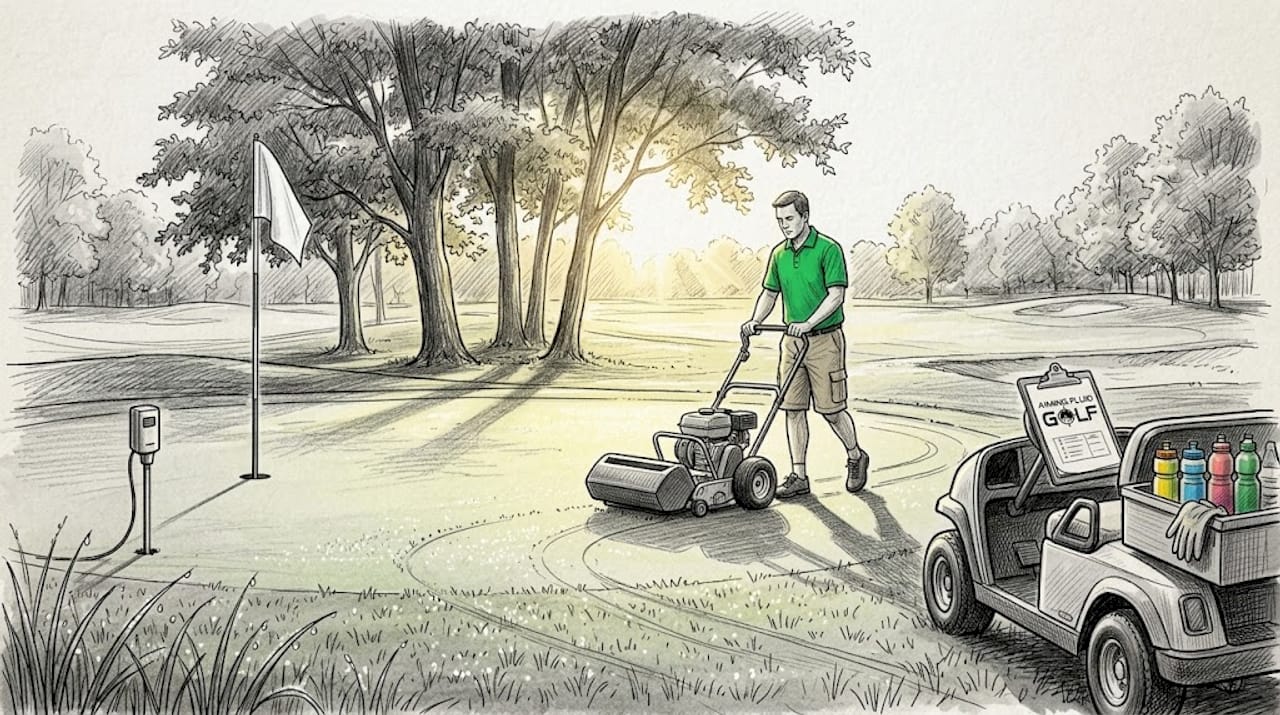
The foundation of any well-maintained course is a repeatable daily system. Superintendents and their crews follow structured schedules that address every playing surface in a specific sequence, and every decision connects back to turf health, player experience, and agronomic data.
Here are the core tasks that define daily course preparation:
- Mowing greens to precise heights. Putting greens are mowed between 0.100 and 0.140 inches, with Stimpmeter readings typically sitting around 9 for standard courses and climbing to 11 or higher for professional-level setups. Fairways are cut to different specifications, usually between 0.5 and 0.75 inches, depending on grass type and season.
- Dew removal before the first cut. Crews use fiberglass poles or heavy ropes to sweep morning moisture from greens before mowing begins. Skipping this step risks fungal disease, uneven cuts, and inconsistent ball roll across the surface.
- Irrigation and moisture control. Watering schedules are calibrated to soil type, temperature forecasts, and recent rainfall. Overwatering softens greens and slows ball speed; underwatering causes firmness that increases unpredictable bounces and surface cracking.
- Bunker raking and edge maintenance. Bunker sand must be leveled and raked consistently. Underneath the sand, bunker liners and drainage layers with perforated pipes prevent erosion and keep the bunker structurally intact over time.
- Pin placement and daily setup. Hole locations rotate to distribute wear across greens. Placement is strategic, accounting for green contour, recent foot traffic patterns, and upcoming weather.
Pro Tip: Pay attention to where the pins were located in your last two rounds. Superintendents rotate placement to protect turf, which means certain zones on any given green will be firmer or softer depending on how recently they received heavy foot traffic.
Technology has changed how these tasks are executed. Moisture and firmness sensors installed on every green now provide real-time data to course managers, allowing precise irrigation adjustments on a green-by-green basis rather than blanket watering schedules. This is one reason why modern courses can maintain more consistent conditions than they could two decades ago.
The science and engineering beneath the surface
Most golfers focus entirely on what they see: the color of the fairway, the speed of the green, the shape of a bunker. What actually determines playability is mostly underground, and this is where the engineering behind course preparation becomes genuinely interesting.
| Infrastructure Element | Purpose | Impact on Play |
|---|---|---|
| Perforated drainage pipes | Remove excess water from beneath greens | Prevents waterlogging, maintains firmness |
| Gravel trench layers | Filter water through profile | Controls drainage rate and soil consistency |
| Geotextile bunker liners | Separate sand from drainage substrate | Preserves bunker integrity over time |
| SubAir-type systems | Regulate soil moisture and temperature | Enables consistent conditions in variable weather |
| Rootzone soil mix | Supports turf root depth and health | Determines resilience under heavy play |
Drainage systems are the most critical hidden infrastructure affecting turf health, soil consistency, and playability across all weather conditions. A course with excellent surface aesthetics but poor subsurface drainage will deteriorate rapidly after heavy rain, producing soft, inconsistent playing conditions that no amount of surface mowing can correct.
Elite courses like Augusta National employ environmental control systems that go even further. Augusta’s SubAir system actively regulates soil moisture and firmness by applying suction or pressure through the drainage network beneath each green. This allows superintendents to achieve specific firmness targets regardless of what the weather delivers, a capability that simply does not exist at most public courses.
Long-term turf management adds another dimension that daily preparation cannot address alone. Integrated turf management programs combining aeration, topdressing, chemical treatment diversity, and patience across multiple years are what actually prevent invasive species like annual bluegrass from degrading playing surfaces. There is no shortcut. Courses that skip this multi-year investment eventually pay for it in surface inconsistency and weed encroachment.
Pro Tip: If a course feels unusually spongy after dry weather, that is often a drainage design issue rather than over-irrigation. Understanding this distinction helps you adjust expectations for ball behavior on approach shots and around the greens.
Soil composition matters as much as any above-ground maintenance. The rootzone mix, typically a sand-based profile designed for drainage and aeration, determines how deeply turf roots can grow and how much wear the surface can absorb. Shallow roots produce weaker turf that cannot recover quickly from divots, spike marks, or ball impacts.
Tournament versus regular play preparation
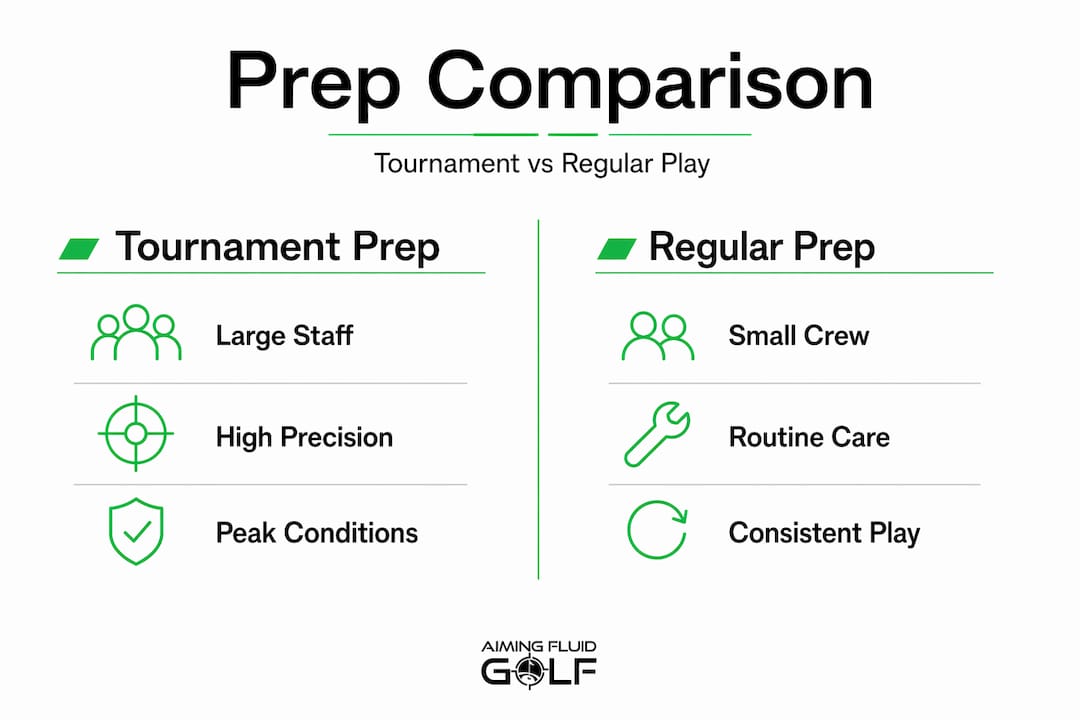
The difference between preparing a course for a weekend member round and preparing it for a professional championship is not just a matter of degree. It is a fundamentally different operational mode.
Consider what preparing a golf course for a major championship actually involves:
- Staffing scale. Elite tournament preparation involves over 100 personnel starting as early as 3:45 a.m., with a target of completing all mowing and detailing by 7:30 a.m. before players begin their rounds.
- Green speed calibration. For professional events, Stimpmeter readings are pushed to 11 or higher. This requires multiple mowing passes, precise rollers, and exact cutting heights executed consistently across all 18 greens simultaneously.
- Coordinated task sequencing. Maintenance teams divide into specialized squads handling greens, tees, fairways, rough, and bunkers in parallel. Each squad follows a timed sequence to avoid equipment conflicts and finish within the pre-dawn window.
- Real-time condition reporting. Moisture and firmness data from sensors on every green is reported directly to governing bodies like the PGA during events, ensuring conditions meet published standards for play.
- Recovery planning. After a high-volume tournament round, superintendents assess wear patterns, schedule targeted aeration or sand topdressing, and adjust irrigation to help the turf recover before the next day’s play.
Course managers also understand that perfection is not a constant state. Golf courses undergo strategic “peaking” rather than sustained top-level condition. The goal is to optimize the course for the specific window when it matters most, whether that is a club championship weekend or a nationally televised event, and then manage recovery in the aftermath.
For regular play, the same principles apply at a smaller scale. Early morning maintenance schedules benefit players by avoiding mid-round disruptions and reduce heat stress on both turf and crew, improving quality and operational safety. Booking an early tee time is not just about avoiding slow play. You are also catching the course at its freshest.
What golfers learn from understanding preparation
Knowing how a course is prepared before you tee off gives you a practical advantage that most players ignore. Here is how that knowledge translates directly to better decision-making on the course:
-
Read morning firmness correctly. Greens will be firmer and faster early in the day, especially after dew removal and the first mowing pass. Plan your approach shots to land short of the pin and release forward rather than expecting them to stop quickly.
-
Factor in daily pin placement rotation. Since mowing patterns and pin placement directly influence turf wear, zones near that day’s pin location will have more foot traffic compaction than the surrounding green surface. Putts through those areas may behave differently from what you expect.
-
Adjust for post-rain conditions. After heavy rainfall, drainage capacity varies between greens based on subsurface design. Older courses or those with lower subsurface investment will have softer, slower greens that reward an aerial approach. Newer courses with superior drainage may recover faster than you anticipate.
-
Protect the surface. Replacing divots, repairing ball marks promptly with a quality divot tool, and raking bunkers properly are not just etiquette requirements. They directly support the maintenance crew’s ability to maintain consistent surfaces. Foot traffic around greens also matters. Walking through the short-grass collar rather than directly through high-wear areas around the cup preserves the turf you benefit from on every visit.
-
Build better pre-round habits. Understanding consistency and confidence in preparation at both the player and course level means arriving early enough to observe conditions before you play. Walk the practice green with purpose, check how balls are releasing, and adjust your read accordingly before the round begins.
My take on the hidden craft behind the greens
I’ve spent enough time watching course operations up close to say this clearly: golfers dramatically underestimate what goes into the surface they play on. Most players notice the result but have no concept of the mechanism producing it.
What changed my perspective was observing pre-tournament preparation at a professional event. The precision involved is closer to surgical than agricultural. Every green receives individual attention, individual moisture readings, and individual mowing treatment. The assumption that all 18 greens are treated the same way is simply wrong.
I’ve also seen the misconception of “perfect greens” play out repeatedly. Golfers blame maintenance when a putt breaks unexpectedly or a chip releases too far. Most of the time, that outcome is the result of reading the course incorrectly, not a maintenance failure. Understanding how sustainable turf management works over years rather than days makes you more patient and more accurate in your reads.
The other thing I’d push back on is the idea that better-looking courses are better-maintained courses. Subsurface investments and drainage yield higher playability benefits than surface treatments. The most beautifully striped fairway on a poorly drained course will play worse than a plain-looking fairway on a course with excellent rootzone engineering. Looks deceive. Infrastructure does not.
My honest advice: spend five minutes before your next round watching the crew work. Not to critique them. To understand them. That shift in perspective will improve how you manage the course, and how much you enjoy the game.
— Gary
Gear that matches your preparation mindset
Understanding the work that goes into preparing a golf course naturally raises the bar for how you prepare yourself. The same discipline that drives great course maintenance applies to what you carry in your bag.

Aimingfluidgolf builds accessories specifically for golfers who show up ready. The magnetic towel system keeps your equipment clean and accessible without digging through your bag mid-round. Precision divot tools help you repair ball marks the right way, protecting surfaces that crews spent hours perfecting. If you want gear that matches your knowledge of the game, start with the expert-picked golf accessories at Aimingfluidgolf. Every product is designed to solve a real problem and keep you focused on your next shot. You can also explore the best divot tool options to find the right tool for protecting greens on every round.
FAQ
What does golf course preparation involve each morning?
Crews remove morning dew, mow greens to precise heights between 0.100 and 0.140 inches, rake bunkers, adjust pin placements, and complete irrigation checks before the first tee time. Most of this work finishes before 7:30 a.m.
How does drainage affect golf course playability?
Subsurface drainage systems using perforated pipes and gravel trenches determine how quickly greens and fairways recover after rain. Poor drainage produces soft, inconsistent surfaces regardless of how well the turf is maintained above ground.
Why do greens play differently in tournaments versus regular rounds?
Tournament courses push Stimpmeter speeds to 11 or higher through tighter cutting heights, additional mowing passes, and precision rolling. Regular play typically targets a Stimpmeter reading of around 9, producing measurably slower and more forgiving green conditions.
How many staff prepare a course for a major championship?
Elite tournament preparation involves over 100 personnel, with crews starting as early as 3:45 a.m. to complete all greens mowing and detailing before players begin their rounds.
How can golfers use course preparation knowledge to play better?
Knowing that greens are firmest early in the morning, that pin rotation affects surface compaction, and that subsurface drainage varies between courses allows you to adapt your approach shots, green reads, and shot selection more accurately throughout the round.
Recommended
- Golf preparation: unlock consistency and confidence – Aiming Fluid Golf
- Golf round preparation guide: boost your game in 2026 – Aiming Fluid Golf
- Winter Golf Survival Guide: Gear & Tips for Rain & Cold – Aiming Fluid Golf
- Top Beginner Golf Mistakes That Kill Your Score (And How to Fix Them) – Aiming Fluid Golf


