


The Rules of Golf define a ball-marker by function, not by a fixed diameter. Almost any small artificial object works, but a marker becomes an illegal alignment device once its height exceeds 1.0 inch or a horizontal dimension exceeds 2.0 inches combined with alignment lines or appendages. The first breach incurs the general penalty for the format being played; repeated use can lead to disqualification.
TL;DR:
- A golf ball marker must not exceed 1.0 inch in height or 2.0 inches in horizontal dimension with alignment features to avoid being classified as an alignment device.
- Markers with printed alignment lines longer than 2.0 inches or with electronic, optical, or measuring components are prohibited as they can artificially aid alignment.
- Acceptable markers include coins, tees, or the toe of a putter, provided they stay within size limits and are used correctly on the green.
- Proper marking involves placing the marker behind or beside the ball, lifting only after marking, and replacing it precisely without causing inconvenience or rule violations.
- Design considerations such as low profile, matte finish, and subtle markings help ensure markers remain compliant and do not distract during play.
Table of Contents
- What Counts as a Ball-Marker Under the Rules of Golf?
- When Does a Marker Become an Illegal Alignment Device?
- Which Ball Markers Are Acceptable, Borderline, or Banned?
- How Big Should Your Ball Marker Actually Be?
- How Do You Properly Mark, Lift, and Replace a Ball?
- Small Design Details That Determine Legality
- Why Ball Markers Deserve More Attention Than They Get
- Get Ball Markers Built to Stay on the Right Side of the Rules
- Sources
What Counts as a Ball-Marker Under the Rules of Golf?
The Rules of Golf give golfers wide latitude on the putting green. Under Rule 14, you may mark, lift, and clean your ball once it comes to rest on the green, and you can mark that spot with any small artificial object: a coin, a tee, a manufactured plastic or metal marker, or even the toe of your putter.
That flexibility is the point. The Rules of Golf were not written to police the diameter of a poker chip. They were written to make sure nobody gains an unfair edge from a device that does more than mark a spot. So instead of publishing a single permitted size, the USGA Rules Hub focuses on what happens on the putting green: marking, lifting, cleaning, and replacing. It says almost nothing about how big a coin can be, because for a normal marker, size was never the issue.
Where size does matter is when a marker stops acting like a marker and starts acting like a tool. That is the entire logic behind the alignment-device rule, and it explains why a marker that would raise no eyebrows on a casual Saturday round can draw a rules official’s attention at a state qualifier.
A few practical notes worth remembering from Rule 14:
- You are not required to use a designated “ball-marker” product. A tee works. A coin works. Even your putter’s toe works, as long as you mark accurately before lifting.
- Cleaning is allowed only while the ball is on the putting green, unless a Local Rule extends that permission elsewhere.
- Replacement must return the ball to its original spot as nearly as possible, not simply “close enough.”
When Does a Marker Become an Illegal Alignment Device?
A marker crosses into “alignment device” territory when its vertical height exceeds 1.0 inch, or when a horizontal dimension exceeds 2.0 inches in combination with alignment markings or physical appendages, according to the USGA’s definition under Rule 4.3. Neither test operates alone. A flat, wide marker with no lines can be larger than 2.0 inches and still pass, because size by itself does not trigger the rule. The combination of size and feature is what matters.
By the numbers: A marker crosses the line into “alignment device” if it stands taller than 1.0 inch, or if it carries a painted or etched alignment line 2.0 inches or longer, per the USGA’s Notice to Ball-Marker Manufacturers.
The USGA spells out the disallowed features directly:
- Painted, etched, or printed alignment lines or arrows measuring 2.0 inches or longer.
- Optical or electronic components designed to assist alignment.
- Measuring or gauging elements built into the marker’s body.
- Appendages or extensions that stretch a feature past the 2.0 inch threshold.
The rationale, according to the USGA’s 2020 clarification, is that these features can “artificially eliminate or reduce the need for skill or judgment.” That is the governing principle behind every dimensional test in the rule.
Penalties follow the standard structure. A first breach draws the general penalty: two strokes in stroke play, loss of hole in match play. Repeated use of a nonconforming marker after being informed of the issue can escalate to disqualification, according to FSGA’s summary of the rule.
Which Ball Markers Are Acceptable, Borderline, or Banned?
Most items golfers already carry pass without issue. A plain coin, a tee laid flat, a low-profile manufactured marker, or the toe of your putter all satisfy Rule 14 with no alignment-device concerns.
Some common items sit closer to the line and deserve a second look:
- Poker chips. Generally fine if they stay low profile with no printed alignment lines. A standard chip runs close to 1.55 inches across, comfortably under the 2.0 inch horizontal threshold.
- Magnetic decorative coins. Check the stack height when magnets are attached, since the combined thickness can approach the 1.0 inch limit faster than the coin alone suggests.
- Any marker with a printed line. A single painted line under 2.0 inches is fine for decoration. Extend that same line to 2.0 inches or longer, and the identical coin becomes a banned alignment device.
Clearly disallowed items include natural objects like leaves or twigs, which the Rules do not recognize as legitimate ball-markers at all, along with any device carrying built-in measurement or electronic alignment features. The line between compliant and noncompliant often comes down to a design decision as small as where a manufacturer stops a printed arrow. FSGA’s guidance makes the same point: officials weigh both the object’s physical characteristics and how a player actually uses it on the green.
How Big Should Your Ball Marker Actually Be?
Coin-sized markers remain the safest practical choice, and a standard poker-chip diameter, generally considered acceptable in most play, works as a practical upper bound for most rounds, according to CaddieHQ’s breakdown of marker sizing. Staying near that range keeps you well clear of the 2.0 inch horizontal threshold even before alignment features enter the picture.
Size is only half the equation. Design choices affect both legality and etiquette:
- A low profile reduces the chance your marker gets clipped by another player’s ball or spike.
- Matte finishes and subtle designs draw less attention during another golfer’s putt, which matters even for markers that are technically legal.
- Bright colors help you find your own marker quickly, but a marker that catches every eye on the green can distract other players mid-stroke.
Pro Tip: Keep two markers in your pocket during a round. If your marker sits in another player’s line, you will need to move it a clubhead length or more to the side, and having a backup means you never have to guess where your original spot was.
If a marker interferes with someone’s line or stance, move it. The standard practice is to shift it a clubhead length to the side, in a direction that avoids the line of play, and remember to move it back before your own stroke. In competition, err toward the stricter interpretation of every rule discussed here. A marker you would use without a second thought in a weekend game is worth reconsidering before a club championship.
How Do You Properly Mark, Lift, and Replace a Ball?
Marking incorrectly is one of the most common self-inflicted penalties in recreational and competitive golf alike. The sequence matters, and skipping a step can turn a routine putt into a two-stroke mistake.
- Mark the spot directly behind or beside the ball using your marker or a club.
- Lift the ball only after it is marked; lifting first is a breach.
- Clean the ball if needed, but only while it remains on the putting green.
- Replace the ball by hand on the exact original spot, not by dropping or placing it approximately.
- Remove the marker before making your stroke. Striking a ball with the marker still in place adds a penalty stroke.
A few special cases come up often. If your ball will not stay on its original spot due to wind or slope, Rule 14 allows you to try once more at the same spot; if it still will not stay, you place it at the nearest spot where it will remain, no nearer the hole. If the original ball becomes unfit for play or is lost after marking, substitution is permitted under the applicable relief procedure. Forgetting to mark before lifting, or replacing on the wrong spot entirely, both carry the general penalty.
Small Design Details That Determine Legality
A plain coin complies without question. No alignment features, no oversized dimensions, nothing for an official to flag.
A poker chip without printed lines generally clears the rule too, provided it stays low profile and under the 2.0 inch horizontal and 1.0 inch height thresholds discussed earlier.
Add one painted line measuring 2.0 inches or longer to that same chip, and it crosses into alignment-device territory. The chip itself did not change size. The added feature did the work.
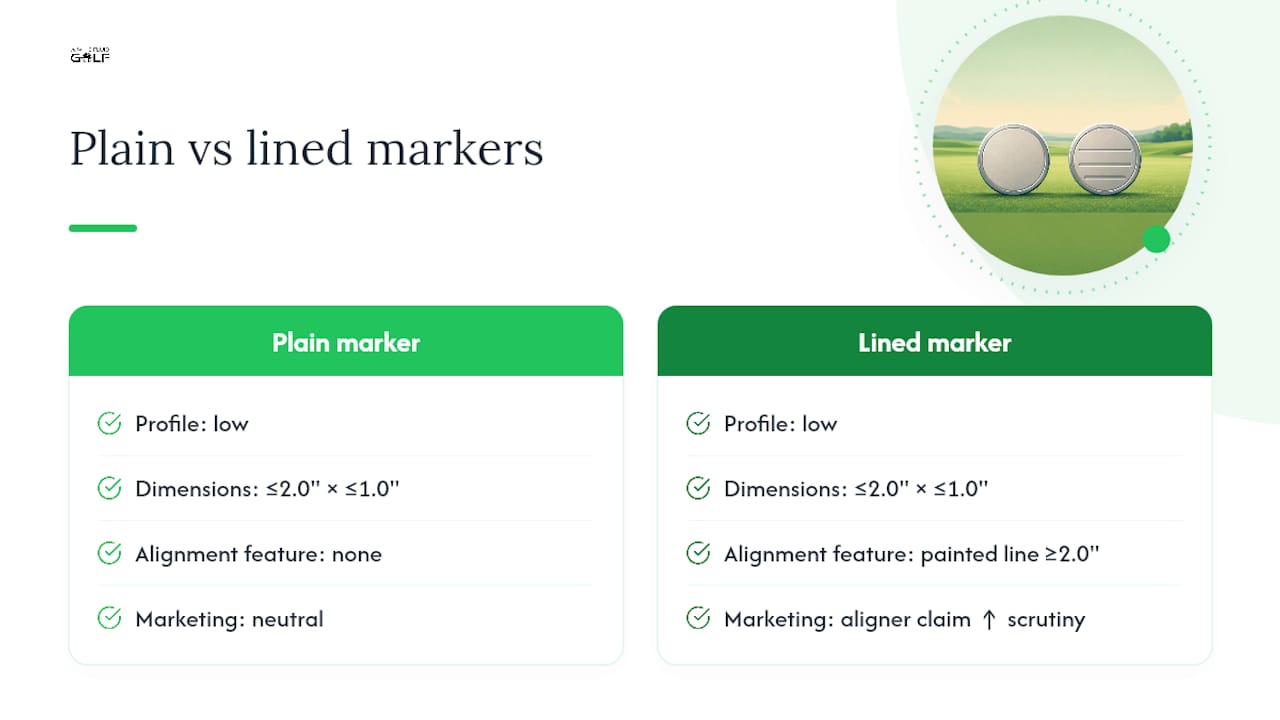
Marketing claims carry weight here as well. The USGA’s notice to manufacturers makes clear that advertising a product primarily as an “aligner” increases the likelihood officials will treat it as a banned alignment device, even when its dimensions sit close to the legal boundary. Intended use, not just measurement, factors into the ruling.
Why Ball Markers Deserve More Attention Than They Get
Golfers spend hours researching drivers and putters, then grab whatever coin happens to be in their pocket for the one accessory that touches every single hole. That gap in attention is where the alignment-device rule quietly catches people.
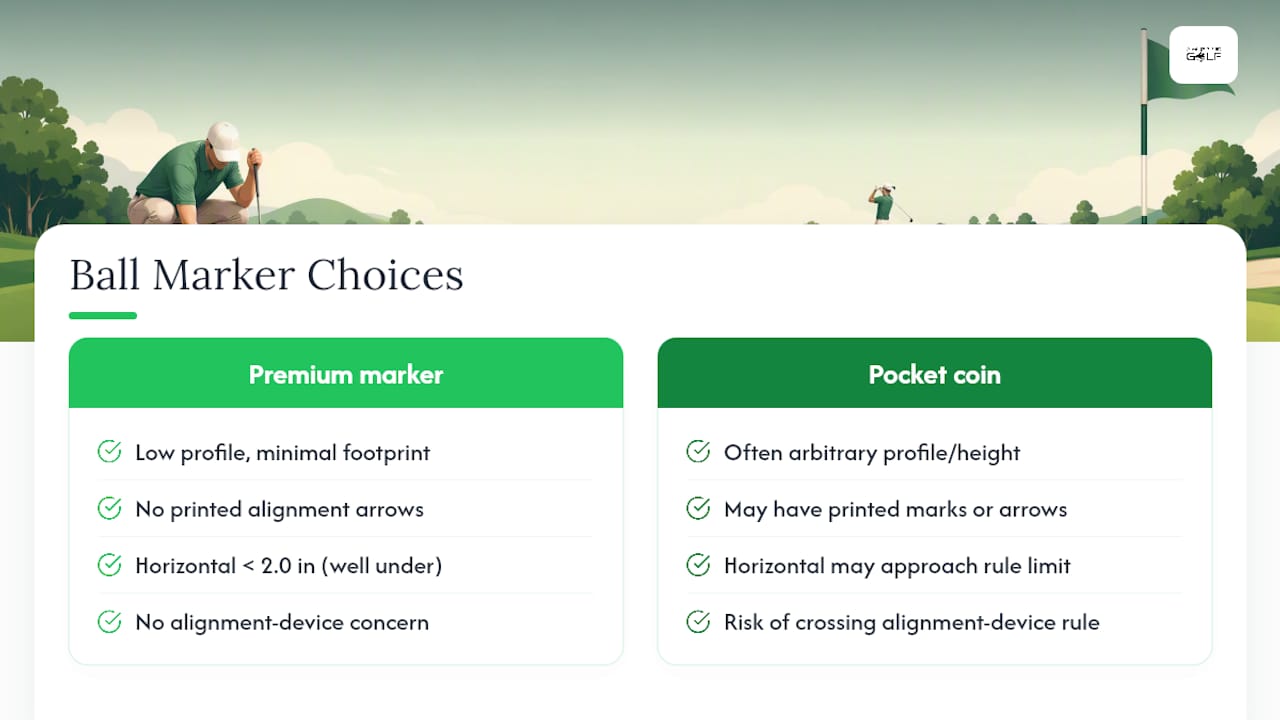
Some premium metal ball markers are built with a focus on low profile, minimal footprint, and no unnecessary appendages that could push a marker toward the alignment-device threshold. A marker that sits flat, skips the printed alignment arrows, and keeps its horizontal dimension well under 2.0 inches is a marker you never have to think twice about, whether you are playing a Sunday scramble or a qualifying round.
Good equipment design in this category is really just good rules literacy translated into metal and finish. If you want markers built with that thinking from the start, the ball markers collection is worth a look before your next round.
— Gary
Get Ball Markers Built to Stay on the Right Side of the Rules
Some metal ball markers are designed with alignment-device thresholds in mind from the initial design stage, aiming to produce markers that stand out visually without printed lines or raised features that might cause noncompliance.

That means you spend less time second-guessing whether a decorative marker will survive a rules official’s second look, and more time focused on the putt in front of you. The ball markers collection covers a range of finishes and styles, all kept low profile by design. Pair one with a divot tool or a set of precision tees if you are rounding out your green-side kit, or browse the full best golf accessories guide for a complete lineup. Visit the ball markers collection today and pick a design that works for both casual rounds and competition play.
Sources
- Rules of Golf: Rule 14 — Marking, lifting and replacing ball
- Rules of Golf - Ball Markers (FSGA)
- Putting green — USGA Rules Hub


